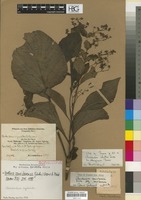
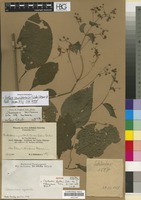
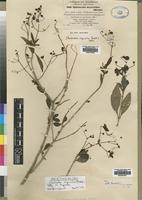
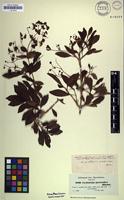
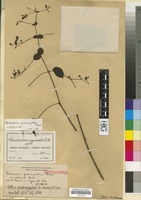
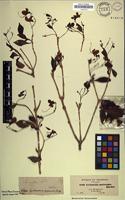
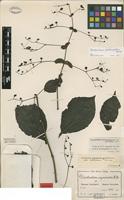
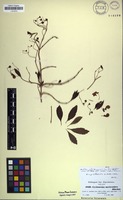
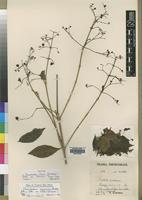
a low erect or scandent shrub, 3–6 ft. high, with leaves and young parts pubescent with short multicellular hairs, or glabrescent; old branches angled, glabrous, striate, with light-brown bark and prominent leaf-scars and lenticels; leaves opposite or whorled, petiolate or subsessile, membranous, oblong, acuminate, acute or rounded at the apex, cuneate at the base, coarsely, irregularly and acutely or obtusely serrate or inciso-serrate towards the apex or subentire, with 4–6 primary lateral nerves on each side, conspicuous beneath, 1 1/2–3 1/2 in. long, 1/2–2 in. broad; petiole puberulous or pubescent, 1/4– 1/2 in. long; cymes bracteate, lax, 1–3-flowered, forming short, loose, glabrous or puberulous panicles, terminal from short leafy axillary branches; bracts and bracteoles linear or linear-lanceolate, pubescent, 1 1/2–3 1/2 lin. long, lower ones frequently larger and leafy; calyx broadly campanulate, 5-lobed, glabrous or glabrescent, 1/6– 1/3 in. in diam.; lobes spreading, broadly ovate, obtuse or rounded at the apex, profusely glandular, leafy, slightly exceeding the tube; corolla-tube short, bent, villous in the throat, otherwise glabrous, up to 1/3 in. long; 4 upper lobes subequal, oblong, obtuse or rounded at the apex, greenish-white, about 1/3 in. long; the lower 1 obovate-spathulate, about twice as long as the upper, concave, usually pale blue; stamens and style far exserted; filaments thickened and densely villous, with shaggy hairs in the lower half; ovary globose, black, glabrous, glandular, 2-celled; ovules 2 in each cell; drupe deeply lobed, 2–3-seeded, 5–6 lin. in diam. near the apex. null