

Compilation
Clematis oweniae
1 Images see all
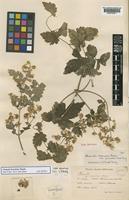
Name
Identification
Clematis oweniae Harv. [family RANUNCULACEAE ] (stored under name); Verified by Burtt Davy, J., Clematis brachiata Thunb. [family RANUNCULACEAE ] Verified by McCallum, D.A., Clematis oweniae Harv. [family RANUNCULACEAE ]
Related name
- Clematis oweniae
- Clematis brachiata
Flora
Entry for Clematis oweniae Harv. [family RANUNCULACEAE]
Herbarium
Royal Botanic Gardens, Kew (K)
Collection
Flora Zambesiaca
Resource Type
Reference Sources
Entry From
FZ, Vol 1, Part 1, page 89, (1960) Author: A. W. Exell and E. Milne-Redhead
Names
Clematis oweniae Harv. [family RANUNCULACEAE], Thes. Cap. 1: 6, t. 9 (1859); in Harv. & Sond., F.C. 1: 2 (1860). — Burtt Davy, F.P.F.T. 1: 111 (1926). Type from Natal (Port Natal).
Clematis brachiata forma [family RANUNCULACEAE], — Bremek. & Oberm. in Ann. Transv. Mus. 16: 413 (1935).
Information
Woody climber very similar to C. brachiata but with leaves twice divided and the ultimate segments deeply incised, sepals not exceeding 1–2 cm. in length, anthers usually about 1 mm. long, sometimes up to 1–5 mm. and achenes (including persistent style) 1–2 cm. long.
Habitat
Probably in woodland and wooded grassland
Altitude range
up to about 1200 m.
1200
0
inferred only top
Distribution
Mozambique M unlocalized, Almeida in Herb. Pret. 12402 (PRE).Zimbabwe S Victoria Distr., fl. 1909, Monro, 1002 (BM; SRGH).Botswana SE Metsimotlaba, near Gaberones, fl. 15.iii.1930, van Son in Herb. Transv. Mus. 28990 (BM; PRE).
Distribution (external)
Transvaal
Swaziland
Natal
Notes
This species, which has a \"Limpopo\" type of distribution is only known, in our area, from a few gatherings. In S. Africa it is said to hybridize with C. brachiata Thunb. and some specimens with anthers 1·5 mm. or so in length, which are difficult to classify, may be of hybrid origin. M. Henderson (in Fl. Pl. Afr.: sub. t. 1197 (1955)) says \"The two species are closely allied and C. brachiata is distinguished by its usually larger less hairy and darker green leaves, longer anthers and the more pleasant scent of the flowers. The young achenes of C. brachiata are usually greenish in colour, while those of C. oweniae are pink or brown\". It should be possible to find this species again in the Victoria District, where Monro collected it in 1909.