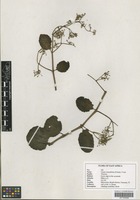
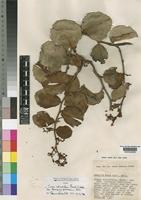
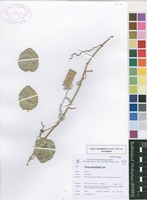
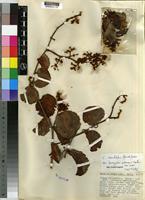
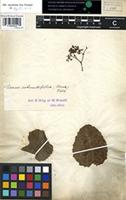
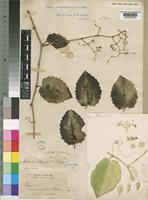
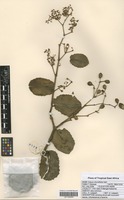
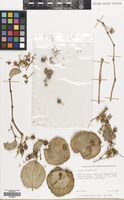
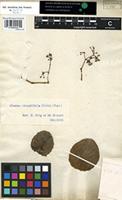
Woody climber, up to 10 m long; young stems glabrous or pubescent, terete; older stems 4-angled or winged, the wings often becoming corky and up to 2.5 cm wide. Leaves thick and fleshy, glaucous, usually sparsely pubescent; petiole 2–40 mm long; blade broadly ovate to suborbicular, 2–13 cm long and wide, ± cordate at the base, rounded at the apex, with crenate or dentate margins. Flowers produced with the leaves, in 2.5–25 cm long inflorescences; peduncle 1–3.5 cm long; pedicels 3–7 mm long, elongating up to 15 mm in fruit. Calyx c. 1 mm long, glabrous. Petals green, yellowish or whitish, 3–3.5 mm long, glabrous. Fruits ellipsoid, 11–15 x 7–13 mm, reddish. Seed ellipsoid, compressed, 8–10 x 5–6 mm, with dorsal ridge but otherwise smooth.
Range
N1; S1–3 Djibouti, Eritrea, Ethiopia and southwards to South Africa
Carmo (Som.). The berries are edible and also the leaves may be cooked and eaten. The author of C. rotundifolia is usually cited as (Forssk.) Vahl, but the alleged basionym, Saelanthus rotundifolius Forssk., is not validly published as the generic name Saelanthus was published without a description.