

Compilation
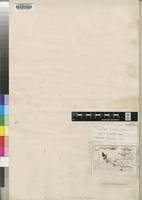
Cissampelos insolita
1 Images see all
Name
Identification
Isotype of Cissampelos insolita Miers [family MENISPERMACEAE ] Verified by Troupin,G., 1954 Cissampelos owariensis P.Beauv. ex DC. [family MENISPERMACEAE ] (stored under name);
Related name
- Cissampelos insolita
- Cissampelos owariensis
Flora
Entry for Cissampelos owariensis [Beauv. ex] DC. [family MENISPERMACEAE]
Herbarium
Royal Botanic Gardens, Kew (K)
Collection
Flora of Tropical East Africa
Resource Type
Reference Sources
Entry From
Flora of Tropical East Africa, page 1, (1956) Author: G. TROUPIN
Names
Cissampelos owariensis [Beauv. ex] DC. [family MENISPERMACEAE], Prodr. 1: 100 (1824); Diels in E.P. IV. 94: 302 (1910); F.W.T.A. 1: 75 (1927) & ed. 2, 1: 75 (1954); T.T.C.L.: 326 (1949); Troupin in F.C.B. 2: 249 (1951), pro parte. Type: Nigeria, Owari [Warri] Beauvois (G-DC., holo.!, BM, iso.!)
Cissampelos insolita [Miers ex] Oliv. [family MENISPERMACEAE], F.T.A. 1: 46 (1868). Type: Gabon, Corisco Bay, Mann 1870 (K, holo.!)
Cissampelos pareira (Beauv. ex DC.) Oliv. var. owariensis [family MENISPERMACEAE], F.T.A. 1: 46 (1868)
Cissampelos pareira (Beauv. ex DC.) Engl. subsp. owariensis [family MENISPERMACEAE], in E.J. 26: 396 (1899)
Cissampelos robertsonii Exell [family MENISPERMACEAE], in J.B. 64: 192 (1936). Type: Togo, Kpandu, Robertson 27 (BM, holo.!)
Information
Liane with stem and branchlets ± densely hairy-pubescent, rarely hairy and puberulous, sometimes ultimately glabrescent; indumentum normally composed of spreading hairs. Leaves with petiole 4–16 cm. long inserted 0.8–2 cm. from the base of the blade; blade broadly ovate, generally suborbicular and angular (with the angles more or less prominent) or broadly triangular, truncate or rounded or subcordate at base, obtuse and mucronulate at apex, with variable indumentum, very rarely glabrous beneath; basal nerves 5–7, palmate. Male inflorescences up to 40 cm. long; cymules with pubescent peduncles 0.5–3 cm. long. Male flowers with sepals 1–1.5 mm. long and 0.7–1.2 mm. wide, hairy outside; corolla cup-shaped, 1–1.2 mm. long. Female inflorescences up to 35 cm. long; bracts suborbicular or reniform, up to 4 cm. in diameter, mucronulate, hairy, longly ciliolate; pedicels 1–1.2 mm. long. Female flowers with sepal 1.2–2 mm. long and 0.7–1 mm. wide; petal truncate or subreniform, 1–1.2 mm. long and wide; carpel 1–1.3 mm. long, hairy. Drupes 4–6 mm. long, 4–5 mm. wide, hairy.
Range
DISTR. T6-8 from Sierra Leone to the Belgian Congo, Angola and Northern Rhodesia
Altitude range
up to 900 m.
Distribution
TANGANYIKA Ulanga District Masagati, June 1931 (fr.), Schlieben 1096!;TANGANYIKA Rungwe District Lupata, Davies 252!;TANGANYIKA Lindi District Rondo Plateau, Mchinjiri, Mar. 1952 (fr.), Semsei 686!
Notes
The Tanganyika specimens are untypical, which, however is not surprising since they come from near the limit of the geographical range of the species. Schlieben 1096 has been annotated in the herbarium as the type of C. ciliosa Peter, a species not however described; the leaves are unusually big, especially in the specimen at Stockholm, and without angles.