

Compilation
Cirsium erosum
1 Images see all
Name
Identification
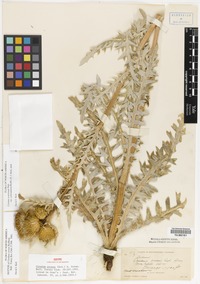
Isotype of Cirsium erosum (Rydb.) K. Schum. [family ASTERACEAE ] (stored under name); Verified by Not on sheet, Cirsium scariosum Nutt. [family ASTERACEAE ] Verified by David J. Keil, 2003 Isotype of Carduus erosus Rydb. [family ASTERACEAE ] Verified by David J. Keil, 1998 Carduus erosus Rydb. [family ASTERACEAE ] Verified by Not on sheet,
Related name
- Cirsium erosum
- Carduus erosus
- Cirsium scariosum
Common name
- Colorado thistle, Flora of North America Vol. 19
Flora
Entry for Cirsium scariosum Nuttall var. coloradense (Rydberg) D. J. Keil [family COMPOSITAE]
Herbarium
Flora of North America (FNA)
Collection
Flora of North America
Resource Type
Reference Sources
Entry From
Flora of North America, Vol 19,
Names
Cirsium scariosum Nuttall var. coloradense (Rydberg) D. J. Keil [family COMPOSITAE], Sida, 21: 215. 2004
Carduus coloradensis Rydberg [family COMPOSITAE], Bull. Torrey Bot. Club, 32: 132. 1905
Cirsium coloradense (Rydberg) Cockerell ex Daniels [family COMPOSITAE]
Cirsium erosum (Rydberg) K. Schumann [family COMPOSITAE]
Cirsium olivescens (Rydberg) Petrak [family COMPOSITAE]
Cirsium tioganum (Congdon) Petrak var. coloradense (Rydberg) Dorn [family COMPOSITAE]
Treatment Author(s)
David J. Keil
Information
Plants usually erect, caulescent (rarely acaulescent), 20–150 cm. Stems usually simple, proximally unbranched, very leafy, ± villous with septate trichomes and/or thinly arachnoid tomentose, often glabrate. Leaves: blades oblanceolate or narrowly elliptic, pinnately lobed, longer spines ± stout, usually 1 cm or shorter, abaxial faces glabrous to thinly gray-tomentose, adaxial glabrous; distal narrow, firm, green throughout or unpigmented proximally. Heads 3–10+, ± sessile or pedunculate, usually in spiciform or racemiform arrays, subtended by ± reduced bractlike distal leaves that often do not overtop the heads. Peduncles 0–18 cm. Involucres 2–3 cm. Phyllaries: outer and mid lanceolate to narrowly ovate, spines slender to stout, 1–5 mm; apices of inner acuminate and entire or serrate, or abruptly expanded into scarious, erose-toothed appendages. Corollas white (rarely purple), 22–29 mm, tubes 11–16 mm, throats 4–5 mm, lobes 6–9.5 mm; style tips 4–6 mm. Cypselae 4–6 mm; pappi 18–25 mm. 2n = 34, 36? (as C. foliosum).
Phenology
jun-aug (summer), sep (fall)
Altitude range
1900–2500 m;
Distribution
USA Ariz.USA Colo.USA N.Mex.USA UtahUSA Wyo.
Discussion
Variety coloradense is common in the mountains of southern and central Colorado with outlying populations in northern New Mexico, northeastern Arizona, central Utah, and southeastern Wyoming. In Colorado it is largely allopatric with the usually acaulescent var. americanum. Some plants from the White Mountains and San Francisco Peaks of Arizona and from Gunnison County, Colorado, approach var. thorneae in having deeply divided, extremely spiny distal leaves that overtop the heads. Putative hybrids between var. coloradense and Cirsium grahamii have been documented in Apache County, Arizona, and between var. coloradense and C. undulatum in Las Animas County, Colorado.