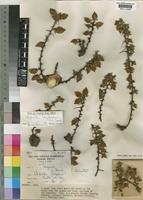
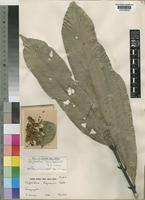
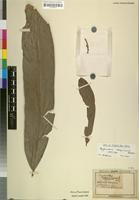
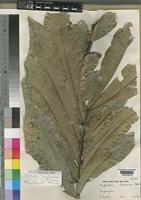
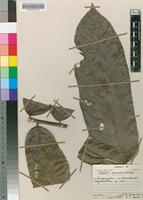
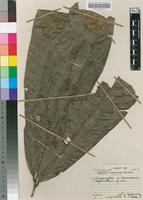
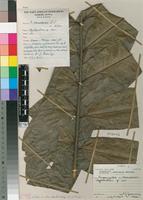
Dioecious or ?monoecious tree or suffrutex, 1.2–6(–15) m. tall, mostly unbranched with apical rosette-like crown of very large leaves; bark grey-brown, smooth or somewhat wrinkled. Leaves drooping and purplish when young, with 7–12 pairs of leaflets; leaf-buds purplish; petiole 1–3 cm. long, ± woody, pubescent; rhachis 35–100 cm. long; petiolules swollen, ± 1 cm. long; leaflets opposite or alternate, elliptic, oblanceolate or oblong-lanceolate, (3–)5.5–45 cm.long, (1.5–)4–14 cm. wide, shortly acuminate at the apex, rounded to cuneate at the base, coriaceous, glabrous save for scattered long hairs on the venation beneath; midrib sunken on upper surface. Inflorescences clusters of thyrses borne on the trunk and branches, pinkish green, 5–15 cm. long, the male and female possibly sometimes on the same plant; buds cream. Calyx pale green velvety, somewhat 2-lipped, tube 3–4 mm. long, lobes very unequal, 2.5–4 mm. long; petals white or yellow-green, oblong, 4–5 mm. long, emarginate or lobed, scale 3.5 mm. long, bent forward but not hooded at the tip, bearing a short simple appendage, hairy at the junction with the petal limb; disk reniform, deeply lobed opposite the petals. Stamens 8; filaments and anthers pilose. Ovary 3-lobed, 3-locular. Mature fruit unknown but very young ones are velvety tomentose and with longer white hairs as well.