JSTOR Global Plants Home
  • Home
  • Browse
  • About
  • Access
  • Account
    • Saved Items
    • Profile
  • Log in

Global Plants

Skip to Main Content
  • JSTOR Global Plants Home
  • Global Plants

    • Browse
    • About
    • Access
    • Account
      • Saved Items
      • Profile
Log in
  • Browse
  • About
  • Access
  • Account
    • Saved Items
    • Profile
Advanced Search

Compilation
Chrysopsis senilis

5 Images see all

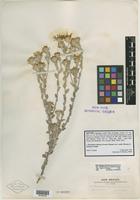
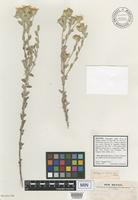
Isotype of Chrysopsis senilis Wooton & Standl. [family ASTERACEAE]
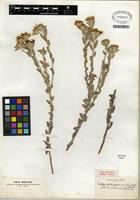
Isotype of Heterotheca fulcrata (Greene) Shinners [family ASTERACEAE]
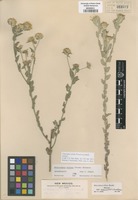
Type of Chrysopsis fulcrata Greene [family ASTERACEAE]
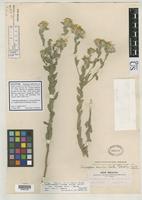
Holotype of Chrysopsis senilis Wooton, E.O. & Standley, P.C. 1913 [family ASTERACEAE]
Isotype of Chrysopsis senilis Woot. & Standl. [family ASTERACEAE]
Previous
Next

Name

Identification
Isotype of Chrysopsis senilis Woot. & Standl. [family ASTERACEAE ] (stored under name); Verified by J.C. Semple, 1997 Heterotheca fulcrata (Greene) Shinners [family ASTERACEAE ] Verified by J.C. Semple, 1997
Related name
  • Chrysopsis senilis
  • Chrysopsis fulcrata
  • Heterotheca fulcrata

Flora

Entry for Heterotheca fulcrata (Greene) Shinners var. senilis (Wooton & Standley) Semple [family COMPOSITAE]
Herbarium
Flora of North America (FNA)
Collection
Flora of North America
Resource Type
Reference Sources
Entry From
Flora of North America, Vol 20,
Names
Heterotheca fulcrata (Greene) Shinners var. senilis (Wooton & Standley) Semple [family COMPOSITAE], Brittonia, 39: 380. 1987
Chrysopsis senilis Wooton & Standley [family COMPOSITAE], Contr. U.S. Natl. Herb., 16: 179. 1913
Treatment Author(s)
John C. Semple
Information
Stems moderately hispido-strigose, sparsely to moderately stipitate-glandular. Distal cauline leaf blades ovate to lanceolate, 12–30 × 4–13 mm, margins sometimes ± undulate, with numerous long-hispido-strigose cilia, faces moderately hispido-strigose, moderately stipitate-glandular. Subtending bracts few, size sometimes nearly equaling distal leaves, sometimes much reduced and remote from heads, faces sparsely to moderately hispido-strigose, sparsely to moderately stipitate-glandular. Involucres 7.5–10 mm (averaging 8.5 mm). Phyllaries sparsely strigose, moderately to faces densely stipitate-glandular. Ray floret laminae 9.5–14 mm (averaging 11.6 mm). Cypsela faces sparsely to moderately strigose. 2n = 18, 36.
Phenology
jun-aug (summer), sep-oct (fall)
Altitude range
700–2300 m;
Distribution
n Mexico.USA Ariz.USA N.Mex.USA Tex.
Discussion
Variety senilis grows in southern New Mexico and trans-Pecos Texas; it is rare in southern Arizona and across northern Mexico. The most hispid form of the species, var. senilis, usually has numerous, spreading, large cilia along much or all of the leaf margins. The leaf margins are sometimes undulate, as in Heterotheca sessiliflora subsp. sessiliflora, and the two could be confused; the ranges do not overlap, however. The variety varies considerably in height and leaf size, and a number of collections are so reduced in size that they are easily mistaken for odd forms of H. villosa var. minor or H. viscida. Plants from southern Arizona often are similar to var. fulcrata. When hair density is high, leaf faces are obscured and the plants appear light grayish green; they could be confused with H. marginata.

Related Materials

  • Terms and Conditions
  • Privacy Policy
  • Cookie Policy
  • Cookie Settings
  • Accessibility
  • Help
  • Contact Us
  • Facebook
  • Twitter
ITHAKA

JSTOR is part of ITHAKA, a not-for-profit organization helping the academic community use digital technologies to preserve the scholarly record and to advance research and teaching in sustainable ways.

©2000-2026 ITHAKA. All Rights Reserved. JSTOR®, the JSTOR logo, JPASS®, Aluka®, and ITHAKA® are registered trademarks of ITHAKA.

╳