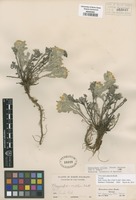
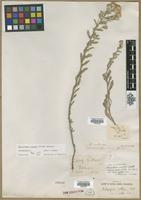
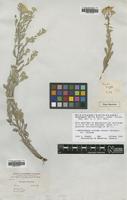
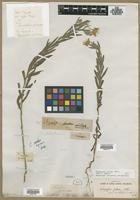
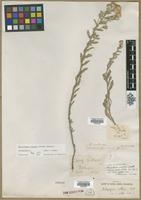
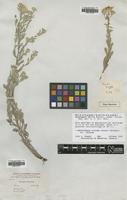
Heterotheca villosa(Pursh) Shinners [family ASTERACEAE ] (stored under name); Verified by John Cameron Semple, Chrysopsis mollisNutt. [family ASTERACEAE ] Verified by John Cameron Semple,
Related name
Chrysopsis villosa
Chrysopsis pilosa
Heterotheca villosa
Chrysopsis mollis
Flora
Entry for Heterotheca villosa (Pursh) Shinners var. villosa [family COMPOSITAE]
Herbarium
Flora of North America (FNA)
Collection
Flora of North America
Resource Type
Reference Sources
Entry From
Flora of North America, Vol 20,
Names
Heterotheca villosa(Pursh) Shinners var. villosa [family COMPOSITAE]
Chrysopsis mollisNuttall [family COMPOSITAE]
Treatment Author(s)
John C. Semple
Information
Stems decumbent to erect, 16–39 cm, moderately to densely strigose, sparsely to abundantly long-hirsute, eglandular or sparsely stipitate-glandular. Distal cauline leaf blades oblanceolate, 21–35 × 3.5–6 mm, bases narrowly cuneate to attenuate, margins flat, apices acute, faces moderately strigose (20–60 hairs/mm2), eglandular or sparsely stipitate-glandular. Heads 1–12(–25). Peduncles (5–)12–47(–67) mm, sparsely to densely hispido-strigose, eglandular; bracts subtending heads usually none, rarely linear-oblanceolate, leaflike. Involucres narrowly cylindric to campanulate (fresh), (5–)6–9(–11) mm. Phyllaries narrowly triangular-lanceolate, margins usually reddish purple distally, faces moderately to densely strigose, eglandular. Ray florets 10–27(–38), laminae (6.5–)8.5–15(–20) mm. 2n = 18, 36.
Variety villosa grows primarily in the Great Plains region; it is rare in Colorado, Idaho, Illinois, Kansas, and Oregon, and represented in Michigan and southern Ontario by chance introduction.