

Compilation
Chrysopsis imbricata
1 Images see all
Name
Identification
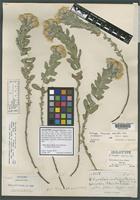
Chrysopsis imbricata A. Nelson [family ASTERACEAE ] (stored under name); Verified by Not on Sheet, Chrysopsis imbricata A. Nelson [family ASTERACEAE ] Verified by John C. Semple, 1997 Heterotheca villosa (Pursh) Shinners [family ASTERACEAE ] Verified by John C. Semple, 1997 Heterotheca null Not on Sheet [family ASTERACEAE ] Verified by John C. Semple, 1985 Chrysopsis imbricata A. Nelson [family ASTERACEAE ] Verified by John C. Semple, 1984 Chrysopsis imbricata A. Nelson [family ASTERACEAE ] Verified by V. L. Harms, 1963 Heterotheca null Not on Sheet [family ASTERACEAE ] Verified by V. L. Harms, 1963 Chrysopsis imbricata A. Nelson [family ASTERACEAE ] Verified by Aven Nelson,
Related name
- Heterotheca
- Heterotheca villosa
- Chrysopsis imbricata
Flora
Entry for Heterotheca villosa (Pursh) Shinners var. foliosa (Nuttall) V. L. Harms [family COMPOSITAE]
Herbarium
Flora of North America (FNA)
Collection
Flora of North America
Resource Type
Reference Sources
Entry From
Flora of North America, Vol 20,
Names
Heterotheca villosa (Pursh) Shinners var. foliosa (Nuttall) V. L. Harms [family COMPOSITAE], Wrightia, 4: 15. 1968
Chrysopsis foliosa Nuttall [family COMPOSITAE], Trans. Amer. Philos. Soc., n. s., 7: 316. 1840
Chrysopsis butleri Rydberg [family COMPOSITAE]
Chrysopsis foliosa var. imbricata (A. Nelson) A. Nelson [family COMPOSITAE]
Chrysopsis imbricata A. Nelson [family COMPOSITAE]
Chrysopsis villosa (Pursh) Nuttall ex de Candolle var. foliosa (Nuttall) Cronquist [family COMPOSITAE]
Heterotheca foliosa (Nuttall) Shinners [family COMPOSITAE]
Treatment Author(s)
John C. Semple
Information
Stems ascending to erect, 22–41(–58) cm, moderately to densely hispido-strigose, eglandular or sparsely stipitate-glandular, often abundantly long-hirsute. Distal cauline leaf blades oblong, rarely ovate, 11–28(–33) × 3.5–8.5(–9.7) mm, sometimes little reduced distally, bases rounded, margins flat, apices broadly acute to obtuse, faces moderately to densely hispido-strigose, (hairs sometimes obscuring faces, 25–59(–90) mm2), eglandular or sparsely stipitate-glandular. Heads 4–24(–35) in congested to open, corymbiforms arrays. Peduncles (9–)17–39 mm, moderately to densely hispido-strigose, eglandular; bracts subtending heads sometimes oblanceolate, leafy, often surpassing them. Involucres narrowly campanulate (fresh), 6–7.6(–8.6) mm. Phyllaries narrowly triangular-lanceolate, margins often reddish purple distally, faces moderately to densely strigose, eglandular to very sparsely glandular. Ray florets (7–)13–22, laminae 8–11.4(–12.4) mm (less showy). 2n = 18, 36.
Phenology
jul-aug (summer), sep-oct (fall)
Altitude range
600–2600 m;
Distribution
USA Colo.USA IdahoUSA Mont.USA Nebr.USA N.Mex.USA N.Dak.USA Oreg.USA S.Dak.USA Wash.Canada Alta.Canada Sask.
Discussion
Variety foliosa is most common at the base of the Front Range in Colorado and Wyoming; it occurs scattered across the northern part of its range in the mountains and western prairies. Plants that are glandular but otherwise like var. foliosa are presumed here to be hybrids with either var. minor or var. nana. Variety foliosa is most similar to var. ballardii. V. L. Harms (2003) treated Saskatchwan plants as members of more broadly defined var. villosa.