JSTOR Global Plants Home
  • Home
  • Browse
  • About
  • Access
  • Account
    • Saved Items
    • Profile
  • Log in

Global Plants

Skip to Main Content
  • JSTOR Global Plants Home
  • Global Plants

    • Browse
    • About
    • Access
    • Account
      • Saved Items
      • Profile
Log in
  • Browse
  • About
  • Access
  • Account
    • Saved Items
    • Profile
Advanced Search

Compilation
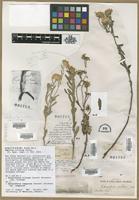
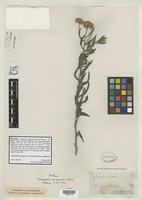
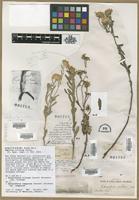
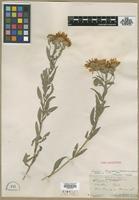
Chrysopsis camporum

8 Images see all

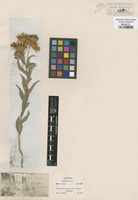
Original material of Chrysopsis camporum Greene [family ASTERACEAE]
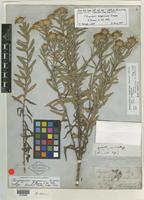
Type? of Chrysopsis camporum Greene [family ASTERACEAE]
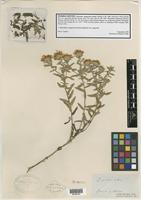
Isotype of Chrysopsis camporum Greene [family ASTERACEAE]
Filed as Chrysopsis villosa (Pursh) Nutt. ex DC. [family ASTERACEAE]
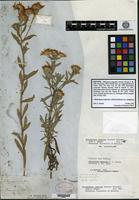
Isotype of Chrysopsis camporum Greene, E.L. 1896 [family ASTERACEAE]
Filed as Chrysopsis villosa (Pursh) Nutt. ex DC. [family ASTERACEAE]
Isotype of Chrysopsis camporum Greene [family ASTERACEAE]
Previous
Next

Name

Identification
Heterotheca camporum (Greene) Shinners [family ASTERACEAE ] (stored under name); Verified by J. C. Semple, Isotype of Chrysopsis camporum Greene [family ASTERACEAE ] Verified by Greene, 1896
Related name
  • Chrysopsis villosa
  • Chrysopsis camporum
  • Heterotheca camporum

Flora

Entry for Heterotheca camporum (Greene) Shinners [family COMPOSITAE]
Herbarium
Flora of North America (FNA)
Collection
Flora of North America
Resource Type
Reference Sources
Entry From
Flora of North America, Vol 20,
Names
Heterotheca camporum (Greene) Shinners [family COMPOSITAE], Field & Lab., 19: 71. 1951
Chrysopsis camporum Greene [family COMPOSITAE], Pittonia, 3: 88. 1896
Chrysopsis villosa (Pursh) Nuttall ex de Candolle var. camporum (Greene) Cronquist [family COMPOSITAE]
Heterotheca villosa (Pursh) Shinners var. camporum (Greene) Wunderlin [family COMPOSITAE]
Treatment Author(s)
John C. Semple
Information
Perennials, 35–110(–150) cm; taprooted, spreading by rhizomes. Stems 1–30(–100), ascending to erect (sometimes reddish brown, sometimes ± brittle), appressed-strigose, sparsely to moderately long-hirsute, eglandular or sparsely to moderately stipitate-glandular, more densely so distally; axillary fascicles absent. Leaves: proximal cauline subpetiolate to sessile, blades oblanceolate, 38–73 cm × 6–15(–18) mm, bases cuneate, margins flat, sparsely serrate, strigoso-ciliate, with a few long cilia proximally, faces moderately long-strigose, eglandular or sparsely to moderately stipitate-glandular; distal sessile (usually spreading, sometimes perpendicular), blades usually narrowly to broadly oblanceolate, rarely obovate or ovate, little reduced distally (not stiff), margins sparsely serrate (not long-ciliate), faces moderately strigose, sparsely to moderately stipitate-glandular. Heads (1–)5–24, usually in open to congested corymbiform arrays, sometimes borne singly, on long peduncular branches. Peduncles 5–35 mm, short-hispido-strigose, sometimes stipitate-glandular; bracts 1–3, proximal leaflike, becoming linear-lanceolate, less hairy and more stipitate-glandular distally, larger bracts subtending heads absent or very rare. Involucres cylindric to campanulo-hemispheric, 7–9(–10.5) mm. Phyllaries in 4–5 series, outer and mid narrowly triangular, unequal, margins hyaline, fimbriate-ciliate apically, faces sparsely strigose, eglandular or sparsely to moderately stipitate-glandular. Ray florets 16–29(–38); laminae 10.5–17(–21.5) × 1–2(–2.6) mm. Disc florets (23–)32–66; corolla barely ampliate, 5–6.6 mm, glabrous, lobes 0.5–1 mm, glabrous or glabrate. Cypselae monomorphic, compressed obconic, 1.7–3.9 mm, ribs 7–10 (often brownish), faces moderately strigose; pappi off-white, outer of linear scales 0.2–1 mm, inner of bristles 5–7 mm, longest weakly clavate.
Distribution
e United States.
Discussion
Chance introductions (usually emphemeral) of Heterotheca camporum have occurred in Michigan, New Jersey, and likely other eastern states. Heterotheca camporum has well-developed serrations along the margins of its distal cauline leaves, which no other species has, although basal leaves in some species may have one or two serrations distally.

Related Materials

  • Terms and Conditions
  • Privacy Policy
  • Cookie Policy
  • Cookie Settings
  • Accessibility
  • Help
  • Contact Us
  • Facebook
  • Twitter
ITHAKA

JSTOR is part of ITHAKA, a not-for-profit organization helping the academic community use digital technologies to preserve the scholarly record and to advance research and teaching in sustainable ways.

©2000-2026 ITHAKA. All Rights Reserved. JSTOR®, the JSTOR logo, JPASS®, Aluka®, and ITHAKA® are registered trademarks of ITHAKA.

╳