JSTOR Global Plants Home
  • Home
  • Browse
  • About
  • Access
  • Account
    • Saved Items
    • Profile
  • Log in

Global Plants

Skip to Main Content
  • JSTOR Global Plants Home
  • Global Plants

    • Browse
    • About
    • Access
    • Account
      • Saved Items
      • Profile
Log in
  • Browse
  • About
  • Access
  • Account
    • Saved Items
    • Profile
Advanced Search

Compilation
Chrysopsis berlandieri

4 Images see all

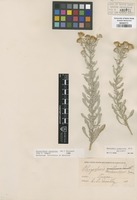
Original material of Chrysopsis berlandieri Greene [family ASTERACEAE]
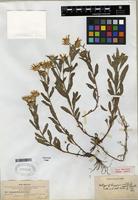
Isotype of Chrysopsis berlandieri Greene [family ASTERACEAE]
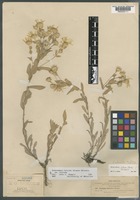
Isotype of Chrysopsis nitidula Wooton & Standl. [family ASTERACEAE]
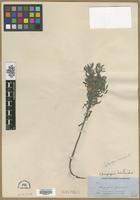
Type? of Aplopappus canescens [family ASTERACEAE]
Previous
Next

Name

Identification
Isotype of Chrysopsis berlandieri Greene [family ASTERACEAE ] (stored under name); Verified by E.L. Greene, Chrysopsis nitidula Wooton & Standl. [family ASTERACEAE ] Verified by Not on sheet, Isotype of Chrysopsis nitidula Wooton & Standl. [family ASTERACEAE ] Verified by Not on sheet,
Related name
  • Chrysopsis canescens
  • Chrysopsis berlandieri
  • Aplopappus canescens
  • Chrysopsis nitidula
Common name
  • Hoary goldenaster, Flora of North America Vol. 20

Flora

Entry for Heterotheca canescens (de Candolle) Shinners [family COMPOSITAE]
Herbarium
Flora of North America (FNA)
Collection
Flora of North America
Resource Type
Reference Sources
Entry From
Flora of North America, Vol 20,
Names
Heterotheca canescens (de Candolle) Shinners [family COMPOSITAE], Field & Lab., 19: 68. 1951
Haplopappus canescens de Candolle [family COMPOSITAE], in A. P. de Candolle and A. L. P. P. de Candolle, Prodr., 5: 349. 1836 (as Aplopappus)
Chrysopsis berlandieri Greene [family COMPOSITAE]
Chrysopsis canescens (de Candolle) Torrey & A. Gray [family COMPOSITAE]
Chrysopsis villosa (Pursh) Nuttall ex de Candolle var. canescens (de Candolle) A. Gray [family COMPOSITAE]
Treatment Author(s)
John C. Semple
Information
Perennials, 15–40(–65) cm; taprooted, frequently rhizomatous (clonal). Stems 1–75, ascending to erect (proximaly sometimes reddish brown, often whitish due to pubescence, sometimes brittle), often short-branched in distal 1/2, usually sparsely long-hispid (more so in tetraploids), distally strigoso-canescent, eglandular (axillary leaf fascicles often present). Leaves generally ascending, congested; proximal cauline petiolate or subsessile, blades oblanceolate, 19–32 × 2–6 mm, bases convex-cuneate to attenuate, margins flat, entire, strigoso-ciliate, proximally long-hispido-strigose, apices acute, faces densely strigose, long-hispid hairs few, eglandular; distal sessile, usually silvery gray-green, blades linear-oblanceolate, 11–29 × 2–5 mm, little reduced distally, apices acute, faces very to extremely densely strigoso-canescent (90–200 hairs/mm²; silvery-whitish), long-hispid hairs usually few, eglandular. Heads 1–9(–15), borne singly or in corymbiform arrays, branches ascending. Peduncles 2–10 mm, densely strigose, usually sparsely hispid; bracts grading from leaves, proximal oblanceolate, sometimes little reduced distally; long, linear-oblancelate, leaflike bracts often subtending heads. Involucres cylindric to narrowly campanulate, 5–7(–7.5) mm (shorter than disc florets). Phyllaries in 4–6 series, linear-lanceolate to lanceolate, unequal (outer lengths 1/5–1/4 inner), margins scarious, distally ciliate and reddish purple, faces moderately strigose, eglandular. Ray florets 10–22; laminae 5–9(–10.5) × 0.8–1.4 mm. Disc florets (14–)22–40(–50); corollas ± ampliate, 4.7–6.5 mm, throats glabrous, lobes 0.5–0.75 mm, lobes sparsely pilose (hairs 0.1–0.25 mm). Cypselae monomorphic, obconic, compressed, 1.2–3.1 mm, ribs 6–10 (sometimes brownish), faces moderately strigose; pappi off-white, outer of linear scales 0.25–0.5 mm, inner of 25–40 bristles 5–7.5 mm, longest weakly clavate. 2n = 18, 36.
Phenology
may (spring), jun-jul (summer), sep (fall)
Altitude range
100–1800 m;
Distribution
USA Kans.USA N.Mex.USA Okla.USA Tex.
Discussion
Heterotheca canescens grows in southcentral Kansas, eastern New Mexico, western Oklahoma, and much of western Texas, with disjunct populations in the Davis and Glass mountains of trans-Pecos Texas. Disjunct collections putatively from Holt County, Missouri, are of questionable provenance. Heterotheca canescens is silvery gray-green due to the very dense indument of appressed hairs (usually more than 100 per mm2). Tetraploids have more hispid stems and more branched arrays than diploids and can be similar to forms of H. stenophylla var. angustifolia that grow sympatrically in west Texas and Oklahoma. The tetraploids of both taxa apparently hybidize, forming local swarms of parentlike and hybrid individuals.

Related Materials

  • Terms and Conditions
  • Privacy Policy
  • Cookie Policy
  • Cookie Settings
  • Accessibility
  • Help
  • Contact Us
  • Facebook
  • Twitter
ITHAKA

JSTOR is part of ITHAKA, a not-for-profit organization helping the academic community use digital technologies to preserve the scholarly record and to advance research and teaching in sustainable ways.

©2000-2026 ITHAKA. All Rights Reserved. JSTOR®, the JSTOR logo, JPASS®, Aluka®, and ITHAKA® are registered trademarks of ITHAKA.

╳