JSTOR Global Plants Home
  • Home
  • Browse
  • About
  • Access
  • Account
    • Saved Items
    • Profile
  • Log in

Global Plants

Skip to Main Content
  • JSTOR Global Plants Home
  • Global Plants

    • Browse
    • About
    • Access
    • Account
      • Saved Items
      • Profile
Log in
  • Browse
  • About
  • Access
  • Account
    • Saved Items
    • Profile
Advanced Search

Compilation
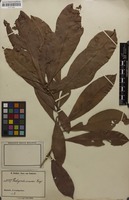
Chrysophyllum cinereum

8 Images see all

Synsepalum brevipes (Baker) T.D.Penn. [family SAPOTACEAE]
Filed as Pachystela cinerea (Engl.) Pierre ex Engl. [family SAPOTACEAE]
Type of Pachystela lenticellosa Radlk. [family SAPOTACEAE]
Synsepalum brevipes (Baker) T.D.Penn. [family SAPOTACEAE]
Isotype of Chrysophyllum cinereum Engl. [family SAPOTACEAE]
Type of Chrysophyllum cinereum Engl. [family SAPOTACEAE]
Type of Pachystela cinerea (Engl.) Radlk. [family SAPOTACEAE]
Previous
Next

Name

Identification
Synsepalum brevipes (Baker) T.D.Penn. [family SAPOTACEAE ] (stored under name); Pachystela cinerea (Engl.) Radlk. [family SAPOTACEAE ] Chrysophyllum cinereum Engl. [family SAPOTACEAE ]
Related name
  • Pachystela brevipes
  • Pachystela lenticellosa
  • Pachystela cinereum
  • Sideroxylon longistylum
  • Pachystela cinerea
  • Chrysophyllum cinereum
  • Synsepalum brevipes

Flora

Entry for PACHYSTELA brevipes (Baker) Engl. [family SAPOTACEAE]
Herbarium
Royal Botanic Gardens, Kew (K)
Collection
Flora of Tropical East Africa
Resource Type
Reference Sources
Entry From
Flora of Tropical East Africa, page 1, (1968) Author: J. H. Hemsley
Names
PACHYSTELA brevipes (Baker) Engl. [family SAPOTACEAE], E.M. 8: 37 (1904); T.S.K.: 120 (1936); T.T.C.L.: 567 (1949); I.T.U., ed. 2: 402 (1952); F.P.S. 2: 375, fig. 140 (1952); Aubrév., Fl. For. Côte d’Ivoire, ed. 2, 3: 148, t. 305/7–12 (1959); K.T.S.: 529 (1961); Fl. Gabon 1: 110 (1961); F.F.N.R.: 322 (1962); Heine in F.W.T.A., ed. 2, 2: 28, fig. 206 (1963); Fl. Cameroun 2: 83, t. 18/1–6 (1964). Types: Zanzibar (I. or coast of mainland opposite), Kirk & Malawi, Lake Nyasa, Kirk (both K, syn.!)
Sideroxylon brevipes Baker [family SAPOTACEAE], in F.T.A. 3: 502 (1877); T.S.K.: 89 (1926)
Chrysophyllum cinereum Engl. [family SAPOTACEAE], in E.J. 12: 522 (1890). Type: Angola, Cuanza Norte, Pungo Andongo, Welwitsch 4824 (BM, K, iso. !)
Sideroxylon sacleuxii Baill. [family SAPOTACEAE], in Bull. Soc. Linn. Paris 2: 911 (1891). Type: Zanzibar I., Sacleux (P, holo.)
Pachystela sacleuxii (Baill.) Baill. [family SAPOTACEAE], in Bull. Soc. Linn. Paris 2: 946 (1891), nom. non rite publ.
Sersalisia brevipes (Baker) Baill. [family SAPOTACEAE], in Bull. Soc. Linn. Paris 2: 947 (1891)
Pachystela brevipes (Baker) Baill. [family SAPOTACEAE], in Bull. Soc. Linn. Paris 2: 947 (1891), nom. non rite publ.
Chrysophyllum stuhlmannii Engl. [family SAPOTACEAE], P.O.A. C: 306 (1895). Types: Mozambique, Zambezia, Quelimane, Stuhlmann (B, syn. †, HBG, isosyn. !) & Malawi, Buchanan 793 (BM, K, isosyn. !)
Pachystela cinerea (Engl.) Engl. [family SAPOTACEAE], E.M. 8: 36 (1904)
Bakeriella brevipes (Baker) Dubard [family SAPOTACEAE], in Ann. Mus. Col. Marseille, sér. 2, 10: 27 (1912), nom. illegit.
Pouteria brevipes (Baker) Baehni [family SAPOTACEAE], in Candollea 9: 290 (1942); Meeuse in Bothalia 7: 333 (1960)
Information
Small to medium tree with dense crown, height up to 35 m.; bole often pillared and deeply fluted. Young shoots and petioles with dense short appressed hairs; old branches glabrous. Petioles up to 1 cm. long; stipules subulate, up to 1.2 cm. long. Leaf-lamina oblanceolate to obovate, 9–20(–26) cm. long, 3.5–8(–10) cm. wide, apex acuminate, obtuse or emarginate, tapering to narrowly cuneate or rarely abruptly obtuse base; upper surface glabrous, lower surface with greyish pubescence of small appressed hairs on young leaves, old leaves often practically glabrous; primary lateral nerves 8–14 on each side, secondary nerves absent, veins oblique and inconspicuous. Flowers fragrant. Pedicels up to 2 mm. long. Sepals connate at base, ovate to elliptic-oblong, up to 4 mm. long, 3 mm. wide, pubescent externally. Corolla yellowish-green or cream; tube up to 2 mm. long; lobes ± elliptic to narrowly ovate, up to 4.5 mm. long, 2.5 mm. wide. Free part of filament up to 5 mm. long; anthers narrowly obcordate, dehiscence extrorse; small membranous ovate-lanceolate or minute triangular staminodes sometimes present. Ovary subconical, up to 2 mm. long; style up to 5 mm. long. Ripe fruits yellow or orange-yellow, edible with pleasant acid flavour, ellipsoid, up to 2.5 cm. long, sometimes beaked; skin thin; pulp soft and milky. Seed ellipsoid, up to 2 cm. long; testa shiny brown, with large pale ± elliptic lateral scar covering up to two-thirds of surface area. Fig. 6.
Range
DISTR. U2, 4; K4, 5, 7; T1, 3, 4, 6–8; Z; P widespread in tropical Africa from Portuguese Guinea to the Sudan Republic and south to Angola, Zambia, Malawi, Mozambique and Rhodesia
Altitude range
0–1500 m.
Distribution
KENYA Embu District Mwimbi, near Mbogoli, Rammel in F.D. 1067 !KENYA Kwale District Shimba Hills, Mwele Mdogo Forest, 28 Aug. 1953 (fl.), Drummond & Hemsley 4032 ! & Makadara Forest, Aug. 1929 (fl.), R. M. Graham in F.D. 2050 !TANGANYIKA Bukoba District Nyakato, Apr. 1935 (fr.), Gillman 259!TANGANYIKA Kilosa District Kidodi, Oct. 1951 (fl.), Eggeling 6301!TANGANYIKA Newala District Chilangala, Gillman 1260 !UGANDA Ankole District Mbarara, Ruizi Falls, June 1938 (fl.), Eggeling 3641!UGANDA Masaka District Byante Central Forest Reserve, June 1951 (fl.), Philip 473! & Sese Is., Bugala I., 9 June 1932 (fl.), A. S. Thomas 168!ZANZIBAR Zanzibar I., 8 km. S. of Chwaka, Mchocha, 8 May 1931 (fl.), Vaughan 1935 ! & Sengenya Dya, 9 Oct. 1951 (fr.), R. 0. Williams 102 !ZANZIBAR Pemba I. , Ngezi Forest, 11 Dec. 1930 (fr.), Greenway 2711 !
Notes
VARIATION. There seems to be some variability in the shape of the apex of the fruit in this species. The thickened and persistent style may be borne at the tip of a rounded or ± rostrate apex, in the latter the base of the style undergoing increased thickening to form part of the structure. The ± rostrate apex would seem to be more frequent in material from the western part of the species range, and the rounded apex in the east and southeast. More observations and information are needed on the distribution and occurrence of these fruit-shape variations. For a more extensive synonymy covering the whole of the geographical range, see Baehni in Candollea 9: 290 (1942) under Pouteria brevipes (Baker) Baehni.

Related Materials

  • Terms and Conditions
  • Privacy Policy
  • Cookie Policy
  • Cookie Settings
  • Accessibility
  • Help
  • Contact Us
  • Facebook
  • Twitter
ITHAKA

JSTOR is part of ITHAKA, a not-for-profit organization helping the academic community use digital technologies to preserve the scholarly record and to advance research and teaching in sustainable ways.

©2000-2026 ITHAKA. All Rights Reserved. JSTOR®, the JSTOR logo, JPASS®, Aluka®, and ITHAKA® are registered trademarks of ITHAKA.

╳