

Compilation
Chorizanthe howellii
1 Images see all
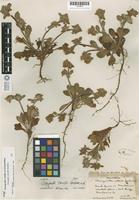
Name
Identification
Chorizanthe howellii Goodman [family POLYGONACEAE ] (stored under name); Verified by Goodman, George Jones, 1933
Related name
- Chorizanthe howellii
Common name
- Howell’s spineflower, Flora of North America Vol. 5
Flora
Entry for Chorizanthe howellii Goodman [family POLYGONACEAE]
Herbarium
Flora of North America (FNA)
Collection
Flora of North America
Resource Type
Reference Sources
Entry From
Flora of North America, Vol 5,
Names
Chorizanthe howellii Goodman [family POLYGONACEAE], Ann. Missouri Bot. Gard., 21: 44, plate 3, fig. 1. 1934
Treatment Author(s)
James L. Reveal
Information
Plants spreading or decumbent to somewhat erect, 0.3–1 × 1–5 dm, villous. Leaves basal or nearly so; petiole 1–4 cm; blade spatulate to broadly obovate, 1–3 × 0.5–1.5(–1.8) cm, villous. Inflorescences with secondary branches sup-pressed, greenish to grayish; bracts 2, similar to proximal leaf blades only reduced, short-petiolate, becoming linear and aciculate at distal nodes, acerose, 1–5 cm × 5–15 mm, awns absent. Involucres 1, greenish to grayish, broadly cylindric, not ventricose, 3–4 mm, with conspicuous, white, scarious margins between teeth and extending up awn, not corrugate, pubescent; teeth spreading, equal, 0.5–1 mm, awns straight with longer ones 1–2 mm and anterior one mostly 2 mm, these alternating with shorter (0.5–1 mm) ones. Flowers exserted; perianth bicolored with floral tube white and tepals white to rose, cylindric, (3–)3.5–4.5 mm, pubescent nearly throughout; tepals connate 1/4 their length, dimorphic, oblong, truncate and erose to denticulate apically, those of outer lobes longer and wider than inner ones; stamens 9, included; filaments distinct, 3–4 mm, glabrous; anthers pink to red, oblong, 0.6–0.8 mm. Achenes light brown, globose-lenticular, 3–4.5 mm. 2n = (72, 74, 76, 78), 80, (82, 84, 86, 88, 90).
Conservation Status
of conservation concern;
Phenology
may (spring), jun-jul (summer)
Altitude range
0–20 m;
Distribution
USA Calif.
Discussion
Chorizanthe howellii is an octoploid probably derived from an ancient hybrid event involving C. cuspidata var. villosa and perhaps C. valida. It is known only from a dune area north of Fort Bragg in Mendocino County, and is federally listed as endangered.