

Compilation
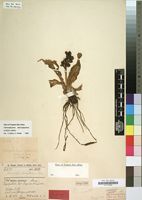
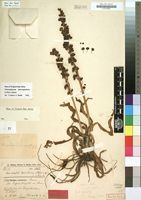
Chlorophytum hyacinthinum
2 Images see all
Name
Identification
Chlorophytum hyacinthinum Peter ex Poelln. [family LILIACEAE ] Verified by Not on sheet., Chlorophytum macrophyllum (A.Rich.) Asch. [family LILIACEAE ] (stored under name); Verified by Not on sheet.,
Related name
- Chlorophytum macrophyllum
- Chlorophytum hyacinthinum
Flora
Entry for CHLOROPHYTUM macrophyllum (A. Rich.) Aschers. [family ANTHERICACEAE]
Herbarium
Royal Botanic Gardens, Kew (K)
Collection
Flora of Tropical East Africa
Resource Type
Reference Sources
Entry From
Flora of Tropical East Africa, page 1, (1997) Author: NORDAL (University of Oslo), SHAKKIE KATIVU (University of Zimbabwe) & AXEL D. POULSEN (University of Copenhagen)
Names
CHLOROPHYTUM macrophyllum (A. Rich.) Aschers. [family ANTHERICACEAE], in Schweinf., Beitr. Fl. Aethiop.: 294 (1867); Baker in J.L.S. 15: 323 (1875) & in F.T.A. 7: 498 (1898); F.P.S. 3: 266 (1956); Polhill in Journ. E. Afr. Nat. Hist. Soc. 24: 13 (1962); F.W.T.A., ed. 2, 3: 99 (1968); E.P.A.: 1535 (1971); Blundell, Wild Fl. E. Afr., reprint: 422, fig. 146 (1992); Nordal & Thulin in Nordic Journ. Bot. 13. 269 (1993); U.K.W.F., ed. 2: 318, t. 145 (1994); Nordal in Fl. Ethiopia 6: 102, fig. 190.8 (1997). Lectotype, chosen by Nordal & Thulin (1993): Ethiopia, Djeladjekanne, Quartin-Dillon (P, lecto.!)
Anthericum macrophyllum A. Rich. [family ANTHERICACEAE], Tent. Fl. Abyss. 2: 334 (1850)
Chlorophytum fuchsianum De Wild. [family ANTHERICACEAE], Ann. Mus. Congo, Bot., sér. 5, 1: 102 (1904). Type: Zaire, Kisantu, Gillet 902 (BR, lecto.!, K, isolecto.!)
Chlorophytum massaicum K. Krause [family ANTHERICACEAE], in E.J. 57: 236 (1921). Type: Tanzania, Arusha, Holtz 3347 (B, holo.!)
Chlorophytum kyimbilense Poelln. [family ANTHERICACEAE], in F.R. 51: 80 (1942). Type: Tanzania, Rungwe District, Kyimbila, Stolz 2358 (B, holo.!, B, iso.!)
Chlorophytum hyacinthinum Poelln. [family ANTHERICACEAE], in Portug. Acta Biol., sér. B, 1: 298 (1946). Type: Tanzania, Arusha District, Meru, Ngare Nanyuki, Peter 2215 (B, holo.!)
Chlorophytum kilimandscharicum Poelln. [family ANTHERICACEAE], in Portug. Acta Biol., sér. B, 1: 300 (1946). Type: Tanzania, Kilimanjaro, Moshi, Merker 417 (B, holo.!)
Chlorophytum longipaniculatum Poelln. [family ANTHERICACEAE], in Portug. Acta Biol., sér. B, 1: 303 (1946). Type: Tanzania, Kilimanjaro, Kibo, Endlich 318 (B, holo.!)
Chlorophytum macrophyllum Poelln. var. kyimbilense [family ANTHERICACEAE], in Portug. Acta Biol., sér. B, 1: 310 (1946). Type: Tanzania, Rungwe District, Kyimbila, Stolz 2335 (B, holo.!, K, iso.)
Dasystachys melanocarpa Chiov. [family ], in Webbia 8: 20, fig. 7A (1951); E.P.A.: 1538 (1971). Type: Ethiopia, Sidamo, Mega, Corradi 4681 (FT holo.!)
Chlorophytum sp. near macrophyllum [family ANTHERICACEAE], sensu Polhill in Journ. E. Afr. Nat. Hist. Soc. 24: 14, fig. 12 (1962)
Chlorophytum sp. A [family ANTHERICACEAE], sensu Hanid in U.K.W.F.: 685 (1974)
Information
Plants 20–80 cm. high, drying yellowish brown to olive-green, very rarely blackish. Rhizome short, compact; roots medium thick, expanding to spindle-shaped tubers up to 3 cm. long. Leaves rosulate, not petiolate nor forming a stem, broadly lanceolate, 10–70 cm. long, 2–10 cm. wide, with undulate or crisped margins, glabrous. Peduncle terete, leafless (or with a few sterile bracts connected to the inflorescence), stout, erect, up to 50 cm. long, glabrous. Inflorescence up to 30 cm., dense, usually unbranched; rhachis glabrous; lower bracts 2.5–6–(13) cm. long, ordinary floral bracts, 2.5–3 cm. long. Pedicels articulated in the upper half, whitish, particularly above the articulation, (8–)10–14 mm. long, 3–5-nate at the lower nodes. Perianth whitish (translucent), turning brownish after anthesis; tepals semi-patent, 8–15 mm. long, 2–4 mm. wide, usually 5-veined. Stamens equal to to shorter than the tepals; filaments fusiform, widest in upper half, scabrid, 3–5 mm. long, somewhat shorter than the 4–6 mm. long anthers. Style declinate. Capsule deltate in cross-section, emarginate, 6–11 mm. long, usually somewhat longer than wide, blackish when dehiscing. Seeds saucer-shaped, ± 2–2.5 mm. in diameter. Fig. 9.
Range
DISTR. K 4–6; T 1–3, 5–7 widespread in tropical Africa from Senegal east to Ethiopia and south to Mozambique and Zimbabwe
Altitude range
100–2800 m.
Distribution
KENYA Nairobi, corner of Uhuru Highway/Langata Road, 8 May 1975, Kabuye & Ng’weno 502!;TANZANIA Masai District near Lake Lagarja, 1 Jan. 1963, Greenway & Turner 10920!;KENYA Masai District Ngong Hills, near Kiserian, 12 Apr. 1960, Verdcourt, Hemming & Polhill 2652! & 34 km. from Narok–Ngorengore, 11 Dec. 1963, Verdcourt 3826!TANZANIA Kondoa District 24 km. N. of Kolo, 12 Jan. 1962, Polhill & Paulo 1143!;TANZANIA Mbeya District Poroto Mts., 20 Jan. 1961, Richards 13990!
Notes
This species has been confused with another broad-leaved species, i.e. the true rain-forest taxon, C. filipendulum Baker, from which it differs by having non-petiolate leaves, generally not drying black, longer pedicels, larger flowers, and particularly the relatively long anthers compared to the length of the filament. C. filipendulum appears to be more closely linked to the C. comosum complex than to C. macrophyllum, although intermediate forms exist also between the latter and C. filipendulum .Chromosome number: 2n=28 (tetraploid), based on countings from Ethiopia, cf. Nordal et al. in Mitt. Inst. Allg. Bot. Hamburg 23 (1990).