JSTOR Global Plants Home
  • Home
  • Browse
  • About
  • Access
  • Account
    • Saved Items
    • Profile
  • Log in

Global Plants

Skip to Main Content
  • JSTOR Global Plants Home
  • Global Plants

    • Browse
    • About
    • Access
    • Account
      • Saved Items
      • Profile
Log in
  • Browse
  • About
  • Access
  • Account
    • Saved Items
    • Profile
Advanced Search

Compilation
Chlorocodon whiteii

7 Images see all

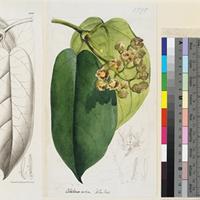
Chlorocodon whiteii Hook.f. original illustration from Curtis's Botanical Magazine
Mondia whitei (Hook.f.) Skeels [family ASCLEPIADACEAE]
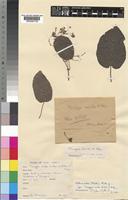
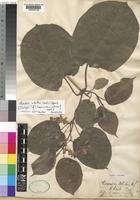
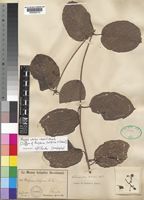
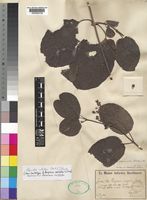
Holotype of Chlorocodon whiteii Hook.f. [family ASCLEPIADACEAE]
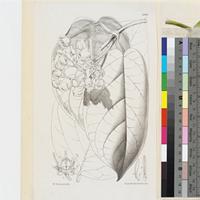
Chlorocodon whiteii Hook.f. published illustration from Curtis's Botanical Magazine
Isotype of Chlorocodon whiteii Hook.f. [family ASCLEPIADACEAE]
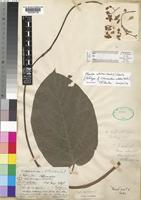
Isoneotype of Periploca latifolia K.Schum. [family ASCLEPIADACEAE]
Type of Periploca latifolia K.Schum. [family ASCLEPIADACEAE]
Previous
Next

Name

Identification
Chlorocodon whiteii Hook.f. [family APOCYNACEAE ]
Related name
  • Chlorocodon whiteii

Flora

Entry for CHLOROCODON Whiteii Hook. f. [family ASCLEPIADACEAE]
Herbarium
Royal Botanic Gardens, Kew (K)
Collection
Flora of Tropical Africa
Resource Type
Reference Sources
Entry From
Flora of Tropical Africa, Vol 4, Part 1, page 231, (1904) Author: (By N. E. Brown.)
Names
CHLOROCODON Whiteii Hook. f. [family ASCLEPIADACEAE], in Bot. Mag. t. 5898. —Engl. & Prantl, Pflanzenfam. iv. 215 & 217, fig. 64, O-Q; Gard. Chron. 1895, xviii. 234 & 243, fig. 48, erroneous as to the corona; Hiern in Cat. Afr. Pl. Welw. i. 680; Wood & Evans, Natal Pl. i. 27, t. 31.
Periploca latifolia K. Schum. [family ASCLEPIADACEAE], in Engl. Pfl. Ost.-Afr. C. 321, and in Engl. Jahrb. xxiii. 232.
Information
Stem climbing, minutely pubescent. Leaves distant, spreading; petiole 1 1/4–2 1/4 in. long; blade 4–7 in. long, 3–5 in. broad; cordate-ovate or cordate-elliptic, cuspidate, glabrous or minutely subscabrous-pubescent on both sides, or softly pubescent beneath. Stipules forming a reflexed toothed frill, connecting the petioles. Flowers in axillary pedunculate paniculate cymes 2 1/2–6 in. long, minutely puberulous on the branches and pedicels; bracts 2–3 lin. long, oblong-lanceolate, acute or acuminate; pedicels 6–9 lin. long. Sepals 2–2 1/2 lin. long, 1–1 1/2 lin. broad, ovate, acute, glabrous or puberulous. Corolla subrotate, 5-lobed nearly to the base; lobes 5–6 lin. long, 3 lin. broad, ovate-oblong, subobtuse, glabrous, very minutely ciliate along one margin, purple, with the margins and a short central stripe at the base green. Coronal-lobes very broadly obcordate, fleshy, white, 1 lin. long, 1 3/4–2 lin. broad, having a widely spreading, subulate, linear or linear-lanceolate, purple dorsal process 2–2 1/2 lin. long, acute or bifid at the apex. Follicles 3–4 in. long, 1 1/2–1 3/4 in. thick, ovoid-lanceolate, obtuse, widely divergent.
Distribution
Angola Lower Guinea Bumbo; in rocky places near the River Bruco, Welwitsch, 4221! Pungo Andongo; Barrancos de Songue, Welwitsch, 4220! along streams throughout the Præsidium, Welwitsch, 4218! in forests, Welwitsch, 4219! Golungo Alto; mountains of Queta, Welwitsch, 4211! 6013!German East Africa Mozamb. Dist. Karagwe; Bukoba, Stuhlmann, 1619.Nyasaland Mozamb. Dist. Shire Highlands, Buchanan, 168!Cameroons Upper Guinea Yaunde, Zenker, 589! 1397!
Notes
Also in Natal, where it is called by the natives “Mundi” or “Umundi,” the root being used as a touic. According to Buchanan the seeds are “said to be used as an arrow poison.” The flowers are represented in the Botanical Magazine as being pale greenish with a purple blotch at the base of the lobes, but in the dried flowers of the type specimen and in all the living flowers I have seen, the colour is as described above. Messrs. Wood & Evans, however, describe a form with “dull greenish-white flowers.” In the Gardener's Chronicle the dorsal processes of the coronal-lobes are inaccurately represented as being incumbent on the backs of the anthers, instead of spreading, which is their natural position in the open flower.

Related Materials

  • Terms and Conditions
  • Privacy Policy
  • Cookie Policy
  • Cookie Settings
  • Accessibility
  • Help
  • Contact Us
  • Facebook
  • Twitter
ITHAKA

JSTOR is part of ITHAKA, a not-for-profit organization helping the academic community use digital technologies to preserve the scholarly record and to advance research and teaching in sustainable ways.

©2000-2026 ITHAKA. All Rights Reserved. JSTOR®, the JSTOR logo, JPASS®, Aluka®, and ITHAKA® are registered trademarks of ITHAKA.

╳