

Compilation
Chenopodium olukondae
1 Images see all
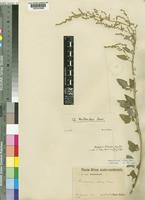
Name
Identification
Chenopodium olukondae (Murr) Murr [family CHENOPODIACEAE ] (stored under name); Verified by Aellen, Chenopodium album L. [family CHENOPODIACEAE ] Verified by Clarke, C. B., Chenopodium album Moq. [family CHENOPODIACEAE ]
Related name
- Chenopodium album
- Chenopodium olukondae
Flora
Entry for Chenopodium olukondae Murr Murr [family CHENOPODIACEAE]
Herbarium
Royal Botanic Gardens, Kew (K)
Collection
Flora Zambesiaca
Resource Type
Reference Sources
Entry From
FZ, Vol 9, Part 1, page 133, (1988) Author: J. P. M. Brenan
Names
Chenopodium olukondae Murr Murr [family CHENOPODIACEAE], in Bull. Herb. Boiss., Sér. 4: 992 (1904).—Aellen in Merxm., Prodr. Fl. SW. Afr. 32: 0 (1967). Type from Namibia.
Chenopodium opulifolium subsp. olunkondae (“oluhondae”) Murr [family CHENOPODIACEAE], in Magyar Bot. Lapok 1: 342 (1902).
Chenopodium album subsp. olukondae Murr Murr [family CHENOPODIACEAE], in Bull. Herb. Boiss., Sér. 2, 4: 992, t. 4 fig. 8 a, b (1904).
Information
Annual herb, (?) sometimes becoming thinly woody below, 0.6–1.5 m. high, much branched especially below, grey to green, uncertain whether red-tinged, more or less clothed with mealy vesicular hairs especially on young parts and inflorescences. Leaves variable, the median and inferior rhombic-triangular to elliptic or ovate in outline, mostly about 1–11/2 times as long as broad, 1.3–3.5 × 1.1–3 cm. cuneate at base, with a pronounced divericate or somewhat deflexed often somewhat bifid lobe in inferior part, otherwise entire or nearly so in superior part, apex of leaves obtuse to subacute; superior leaves smaller, entire or subentire, elliptic to elliptic-lanceolate. Inflorescence an ample profusely branched panicle of very numerous small laxly spicately arranged dense rounded clusters (“glomerules”) of minute greyish or grey-green flowers 1–1.5 mm. diam. Perianth segments 5, papillose with grey mealy hairs on margins and outside, each with a prominent green keel in upper part. Stamens 5. Pericarp readily rubbed or scraped off. Seeds black, shining, subcircular, 1.1–1.5 mm. in diam., rather sharply keeled; testa (seen under microscope) with numerous rather close radial impressed furrows.
Habitat
Habitat insufficiently known: Ngoni 272 from a limestone outcrop.
Distribution
Botswana SE Tlalambele-Moru area, near Soa Pan, fl. 8.i.1974, Ngoni 272 (K; SRGH).
Distribution (external)
S. Africa
Namibia
Notes
The material of C. olukondae from the Flora Zambesiaca area is inadequate for certainty, especially in that it lacks ripe seeds. The relationship of C. olukondae with C. opulifolum is clearly very close. However, the foliage appears distinctive (see key) and also the rather sharp keel to the seeds. More material and observation is much needed.Three specimens from Mozambique are close to C. olukandae, though evidently from very different habitats: GI: Maputo st. ix. 1944, Pimenta 4901 (LISC); Gaza, Chibuto, Maniquenique, Experimental Station, near houses, fr. 13.x.1957, Barbosa & Lemos 8023 (K); M: Inhaca Isl., basic sandy soil; 0–200 m., fl. 30.ix.1958, Mogg 28432 (K). Again, more material is desired.