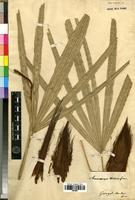
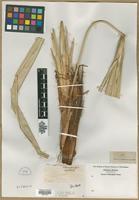
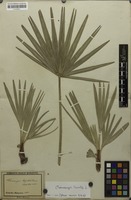
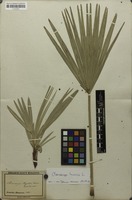
Entry for Rhapidophyllum hystrix (Pursh) H. Wendland & Drude [family PALMAE]
Entry From
Flora of North America, Vol 22,
Names
Rhapidophyllum hystrix (Pursh) H. Wendland & Drude [family PALMAE], Bot. Zeitung (Berlin), 34: 803. 1876
Chamaerops hystrix Pursh [family PALMAE], Fl. Amer. Sept., 1: 240. 1814
Sabal hystrix (Pursh) Nuttall [family PALMAE]
Rhapis caroliniana Hort ex Kunth [family PALMAE]
Sabal hystrix (Pursh) Nuttall [family PALMAE]
Discussion
The palm usually grows prodecumbently with adventitious roots emerging from the trunk where it contacts moist soil (A. G. Shuey and R. P. Wunderlin 1977). In the wild, Rhapidophyllum forms suckers along its stem, and it is thatis vegetative reproduction, more than seedling reproduction, that maintains most populations (K. E. Clancy and M. J. Sullivan 1988).
Flowers are protandrous and most likely to be pollinated by a species of Notolomus (Coleoptera: Curculionidae). The evil-smelling and curiously hirsute fruits are taken by black bears (D. S. Maehr and J. R. Brady 1984) and other mammals (A. G. Shuey and R. P. Wunderlin 1977).