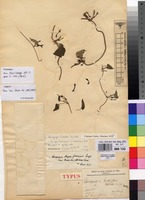
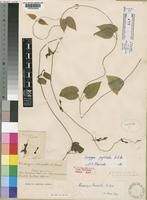
Ceropegia verdickiiDe Wild. [family APOCYNACEAE ] Verified by Not on sheet, Ceropegia meyeri-johannisEngl. [family APOCYNACEAE ] (stored under name); Verified by Not on sheet,
Related name
Ceropegia calcarata
Ceropegia papillata
Ceropegia verdickii
Ceropegia meyeri-johannis
Flora
Entry for Ceropegia Verdickii De Wild. [family ASCLEPIADACEAE]
Herbarium
Royal Botanic Gardens, Kew (K)
Collection
Flora of Tropical Africa
Resource Type
Reference Sources
Entry From
Flora of Tropical Africa, Vol 4, Part 1, page 231, (1904) Author: (By N. E. Brown.)
Names
Ceropegia VerdickiiDe Wild. [family ASCLEPIADACEAE], Études Fl. Katanga, i. 109.
Information
Stem twining, pubescent. Leaves spreading; petiole about 8 in. (“20 cm.”) long; blade up to 1 2/3 in. long and 1 in. broad, oblong-cordate, acuminate, sometimes slightly 3-lobed, pubescent on both sides, with prominent veins beneath. Cymes lateral, subsessile, or with a thick peduncle up to 1 1/4 lin. long, 3–11-flowered. Bracts linear, pubescent. Pedicels 3 1/2–4 lin. long. Sepals 1 1/2–2 lin. long, linear, pubescent. Corolla about 9 1/2 lin. long; tube inflated and about 1 3/4 lin. in diam. at the base, 1/2 lin. in diam. at the middle enlarging to 2 1/2 lin. at the mouth, glabrous outside; lobes about 2 lin. long, pubescent with spreading hairs, purple. Corona 3/4 lin. long, otherwise undescribed.