JSTOR Global Plants Home
  • Home
  • Browse
  • About
  • Access
  • Account
    • Saved Items
    • Profile
  • Log in

Global Plants

Skip to Main Content
  • JSTOR Global Plants Home
  • Global Plants

    • Browse
    • About
    • Access
    • Account
      • Saved Items
      • Profile
Log in
  • Browse
  • About
  • Access
  • Account
    • Saved Items
    • Profile
Advanced Search

Compilation
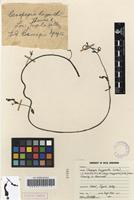
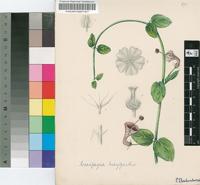
Ceropegia haygarthii

2 Images see all

Ceropegia haygarthii Schltr.
Filed as Ceropegia haygarthii Schltr. [family APOCYNACEAE]
Previous
Next

Name

Identification
Ceropegia haygarthii Schltr. [family APOCYNACEAE ]
Related name
  • Ceropegia haygarthii

Flora

Entry for CEROPEGIA Haygarthii Schlechter [family ASCLEPIADACEAE]
Herbarium
Royal Botanic Gardens, Kew (K)
Collection
Flora Capensis
Resource Type
Reference Sources
Entry From
Flora Capensis, Vol 4, page 518, (1909) Author: By N. E. BROWN.
Names
CEROPEGIA Haygarthii Schlechter [family ASCLEPIADACEAE], in Engl. Jahrb. xxxviii. 46, fig. 7A
Information
stem climbing, fleshy, 1 1/2–2 lin. thick, glabrous; leaves small, fleshy, flat, 1/4– 2/3 in. long, 1/8– 1/4 in. broad (see note below), ovate or ovate-anceolate, acuminate; cymes 1–2-flowered, lateral at the nodes; peduncles 3/4–1 1/2 in. long, glabrous; bracts 1–2 lin. long, subulate; pedicels 5–7 lin. long, glabrous; sepals 5lin. (2 1/2 lin., Schlechter) long, subulate, glabrous; corolla abruptly bent at a right-angle near the base; tube (following the bend) about 1 1/3 in. long according to a drawing, or about 1 in. long in dried flowers, globosely inflated at the base, cylindric above, enlarging according to a drawing to about 3/4 in. in diam. at the mouth, pinkish-white or greenish tinted, spotted with violaceous, glabrous outside, pilose with very fine long hairs within; lobes free at the base, abruptly inflexed over the mouth of the tube and produced beneath into broad triangular partition-like green plates or keels, meeting at the centre and connate into a slender erect column 5–7 lin. long, then again becoming free and expanding into elliptic-lanceolate replicate segments connate at the tips, forming a small apical ellipsoid cage-like body 2 1/2–3 lin. long, ciliate on the margins, dull purple or purple-brown; corona in the flowers seen much eaten by insects, but apparently the outer corona is cupular, with 5 acutely bifid lobes rising to the level of the top of the staminal column, ciliate and hairy within with long fine hairs; inner corona-lobes 1 lin. long, linear or linear-spathulate, connivent-erect over the staminal column, with very revolute tips. null
Distribution
COAST REGION Stockenstrom Div.; Maasdorp, in forest, Scully, 196!EASTERN REGION Natal; without precise locality, McKen! Sanderson! also flower from a plant cultivated at Cape Town, Barkly!
Notes
In the Kew Herbarium is a copy of a drawing made by Mr. Sanderson (from which drawing the figure published by Dr. Schlechter would seem originally to have been also copied) in which the leaves are represented as subsessile, and as described above, but in another drawing of this species at Kew they are represented as very distinctly petiolate. Dr. Schlechter described from the drawing only, but the Kew Herbarium contains a few loose leaves sent with a flower by McKen, which are as follows:—petiole 2–3 lin. long; blade 3/4–1 1/4 in. long, 1/3– 1/2 in. broad, ovate-lanceolate, acuminate to a very acute point, slightly subcordate at the rounded base, glabrous on both sides; the largest leaf with Scully's specimen is about 1 in. long and 3/4 in. broad, broadly ovate, and the peduncles are 2–4-flowered, but it otherwise seems the same species.

Related Materials

  • Terms and Conditions
  • Privacy Policy
  • Cookie Policy
  • Cookie Settings
  • Accessibility
  • Help
  • Contact Us
  • Facebook
  • Twitter
ITHAKA

JSTOR is part of ITHAKA, a not-for-profit organization helping the academic community use digital technologies to preserve the scholarly record and to advance research and teaching in sustainable ways.

©2000-2026 ITHAKA. All Rights Reserved. JSTOR®, the JSTOR logo, JPASS®, Aluka®, and ITHAKA® are registered trademarks of ITHAKA.

╳