JSTOR Global Plants Home
  • Home
  • Browse
  • About
  • Access
  • Account
    • Saved Items
    • Profile
  • Log in

Global Plants

Skip to Main Content
  • JSTOR Global Plants Home
  • Global Plants

    • Browse
    • About
    • Access
    • Account
      • Saved Items
      • Profile
Log in
  • Browse
  • About
  • Access
  • Account
    • Saved Items
    • Profile
Advanced Search

Compilation
Ceropegia barklyi

7 Images see all

Ceropegia barklyi Hook.f.
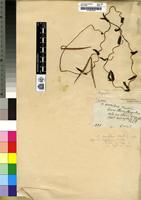
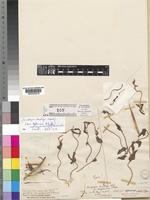
Holotype of Ceropegia barklyi Hook.f. var. tugelensis NE. Br. [family ASCLEPIADACEAE]
Ceropegia barklyi Hook.f. [family ASCLEPIADACEAE]
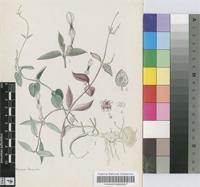
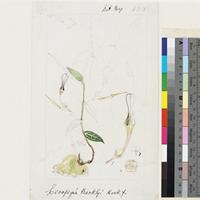
Ceropegia barkleyi Hook.f. original illustration from Curtis's Botanical Magazine
Type of Ceropegia barklyi Hook.f. var. tugelensis N.E.Br. [family ASCLEPIADACEAE]
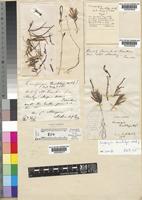
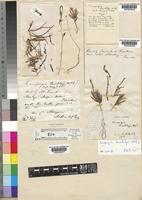
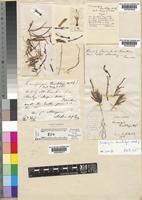
Type of Ceropegia barklyi Hook.f. [family ASCLEPIADACEAE]
Previous
Next

Name

Identification
Ceropegia barklyi Hook.f. [family APOCYNACEAE ]
Related name
  • Ceropegia barklyi

Flora

Entry for CEROPEGIA Barklyi Hook. f. [family ASCLEPIADACEAE]
Herbarium
Royal Botanic Gardens, Kew (K)
Collection
Flora Capensis
Resource Type
Reference Sources
Entry From
Flora Capensis, Vol 4, page 518, (1909) Author: By N. E. BROWN.
Names
CEROPEGIA Barklyi Hook. f. [family ASCLEPIADACEAE], in Bot. Mag. t. 6315, by error Barkleyi;—Schlechter in Journ. Bot. 1897, 294.
Information
rootstock a tuber with 1 or more erect stems 2–6 in. long, simple, sometimes slightly twining at the apex, under cultivation up to 1 1/2 ft. long and requiring support, or occasionally twining, pubescent when dwarf, glabrous when elongated; leaves fleshy, very shortly petiolate, 1/2–1 1/4 in. long, 1–5 lin. broad, linear to lanceolate, acute, rounded or somewhat cuneate at the base, flat above, slightly convex beneath, shortly and rather thinly pubescent to glabrous on both sides, slightly and minutely ciliate, dark green with whitish veins; peduncles lateral at the nodes, 2–9 lin. long, 2–3-flowered, glabrous; bracts 1/2–1 lin. long, subulate; pedicels 1 1/2–2 1/2 lin. long, glabrous; sepals 1 1/2 lin. long, subulate, glabrous; corolla-tube slightly curved (straight in dried flowers), 7–8 lin. long, about 2 lin. in diam. at the globose-inflated base, cylindric and about 3/4 lin. in diam. above, about 1/4 in. in diam. at the funnel-shaped mouth, outside glabrous, greenish-white at the base, pinkish above, passing into light green at the mouth, inside with a few fine long hairs on the upper part; lobes 2/3– 3/4 lin. long, very narrowly linear from a deltoid base, erect, diverging above (in dried flowers subparallel), with incurved connate tips, keeled on the inner face, which is veined with purple-brown on a greenish ground at the base and entirely purple-brown above, green on the back, ciliate on the margins for a short space just below the middle and on the basal part of the keel with fine simple purple hairs, otherwise glabrous; outer corona somewhat cup-like or its lobes pouch-like, subtruncate or slightly notched, glabrous; inner corona-lobes 1/2– 2/3 lin. long, 1/3 lin. broad across the side, laterally much compressed, broadly falcate, obtuse, connivent over the style-apex at the base, then recurved in a semicircle above the outer corona and dorsally connected to it at the base, glabrous; follicles spreading, 1 1/2 in. or more long, 1/8 in. thick, linear-terete, shortly acute; seeds 1 1/2–1 3/4 lin. long, 2/3– 3/4 lin. broad, ovate, broadly margined, smooth, glabrous, brown. null
Distribution
EASTERN REGION Transkei; near Old Morley, Bowker! and living plant sent to Kew by Sir H. Barkly! Var. β: Natal; thorny bush, Tugela River, Gerrard, 1323!
Notes
The follicles described, are from a plant cultivated by Mr. W. E. Ledger of Wimbledon, and appear to me not to have fully developed. The Tugela plant may prove to be a distinct species when better known; it looks very different from the wild specimens of C. Barklyi, but except in its very twining stems is scarcely distinguishable from that plant as it grows under cultivation, for no one would recognise that the figure in the Botanical Magazine (which is excellent of the cultivated plant) belonged to the same species as the wild specimens, so very different are they in appearance, although in this case actually grown from the same tubers.

Related Materials

  • Terms and Conditions
  • Privacy Policy
  • Cookie Policy
  • Cookie Settings
  • Accessibility
  • Help
  • Contact Us
  • Facebook
  • Twitter
ITHAKA

JSTOR is part of ITHAKA, a not-for-profit organization helping the academic community use digital technologies to preserve the scholarly record and to advance research and teaching in sustainable ways.

©2000-2026 ITHAKA. All Rights Reserved. JSTOR®, the JSTOR logo, JPASS®, Aluka®, and ITHAKA® are registered trademarks of ITHAKA.

╳