

Compilation
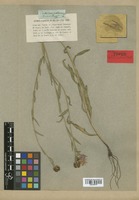
Centaurea thuillieri
1 Images see all
Name
Identification
Centaurea thuillieri (Dostál) J. Duvign. & Lambinon [family COMPOSITAE ] (stored under name); Verified by Data not digitized, Centaurea pratensis Thuill. [family COMPOSITAE ] Verified by Data not digitized,
Related name
- Centaurea pratensis
- Centaurea thuillieri
Common name
- Meadow or protean knapweed, Flora of North America Vol. 19
Flora
Entry for Centaurea ×moncktonii C. E. Britton [family COMPOSITAE]
Herbarium
Flora of North America (FNA)
Collection
Flora of North America
Resource Type
Reference Sources
Entry From
Flora of North America, Vol 19,
Names
Centaurea ×moncktonii C. E. Britton [family COMPOSITAE], Bot. Soc. Exch. Club Brit. Isles, 6: 172. 1921
Centaurea debeauxii Godron & Grenier subsp. thuillieri Dostál [family COMPOSITAE]
Centaurea jacea Linnaeus var. pratensis W. D. J. Koch [family COMPOSITAE]
Centaurea jacea subsp. ×pratensis (W. D. J. Koch) Celakovsky [family COMPOSITAE]
Centaurea nigra Linnaeus var. radiata de Candolle [family COMPOSITAE]
Centaurea thuillieri (Dostál) J. Duvigneaud & Lambinon [family COMPOSITAE]
Past names
monktonii
Treatment Author(s)
David J. Keil
Jörg Ochsmann
Information
Perennials, 30–150 cm. Stems 1–few, erect or ascending, openly branched distally, villous to scabrous with septate hairs and loosely tomentose, ± glabrate. Leaves: basal and proximal cauline petiolate, blades oblanceolate or elliptic, 5–25 cm, margins entire or shallowly dentate to irregularly pinnately lobed; distal cauline sessile, not decurrent, blades linear to lanceolate, gradually smaller, entire or dentate. Heads usually radiant (rarely discoid), in few-headed corymbiform arrays, borne on leafy-bracted peduncles. Involucres ovoid to campanulate or hemispheric, 15–l8 mm, usually ± as wide as high. Principal phyllaries: bodies lanceolate to ovate, loosely tomentose or glabrous, usually concealed by expanded appendages, appendages erect, overlapping, light to dark brown, flat or ± concave, margins varying from coarsely dentate to pectinately dissected into ± wiry lobes. Inner phyllaries: tips truncate, irregularly dentate or lobed. Florets 40–100+, all fertile or the peripheral sterile; corollas purple (rarely white), those of sterile florets ± expanded and exceeding corollas of fertile florets, those of fertile florets 15–18 mm. Cypselae tan, 2.5–3 mm, finely hairy; pappi 0 or of many unequal, sometimes caducous bristles 0.5–1 mm. 2n = 22 (England), 44.
Phenology
mar-may (spring), jun-aug (summer), sep-nov (fall)
Altitude range
0–1000 m;
Distribution
Europe.USA Calif.USA Conn.USA IdahoUSA Ill.USA MaineUSA Mass.USA Mich.USA Minn.USA Mo.USA Mont.USA N.H.USA N.J.USA N.Y.USA OhioUSA Oreg.USA Pa.USA R.I.USA Vt.USA Va.USA Wash.USA Wis.Canada B.C.Canada Nfld. and Labr.Canada N.S.Canada Ont.Canada Que.
Discussion
Centaurea ×moncktonii is native to Europe or originated in North America from European ancestry.
Meadow knapweeds represent an array of mutually interfertile intermediates derived by hybridization and backcrossing among the various cytotypes of the Centaurea jacea complex. The plants variously combine features of C. jacea and C. nigra, and perhaps C. nigrescens as well. The hybrid complex includes both diploids and tetraploids. Extremes approach the parental types. Meadow knapweeds are often present without either parent in the immediate vicinity. They are considered to be noxious weeds in British Columbia, Idaho, Oregon, and Washington.
Centaurea pratensis J. L. Thuillier, sometimes applied to plants that belong here, is not a legitimate name.
Native/Introduced
introduced;