

Compilation
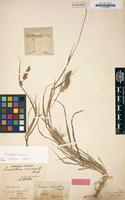
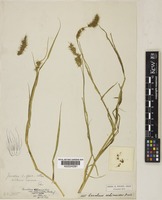
Cenchrus echinoides
2 Images see all
Name
Identification
Cenchrus echinoides Wight ex Steud. [family GRAMINEAE ] (stored under name); Verified by Not on sheet.,
Related name
- Cenchrus echinoides
Flora
Entry for CENCHRUS pennisetiformis Hochst. & Steud. ex Steud. [family POACEAE]
Herbarium
Royal Botanic Gardens, Kew (K)
Collection
Flora of Tropical Africa
Resource Type
Reference Sources
Entry From
Flora of Tropical Africa, Vol 9, page 1, (1917) Author: (By O. STAPF.)
Names
CENCHRUS pennisetiformis Hochst. & Steud. ex Steud. [family POACEAE], Nomencl. Bot. ed. 2, i. 217 (1840), name only and Syn. Pl. Glum. i. 109 (1854). —Boiss. Fl. Orient. v. 448; Chiov. in Ann. Istit. Bot. Roma, viii. 43 (1903).
CENCHRUS pennisetiformis Chiov. var. typica [family POACEAE], l.c.
CENCHRUS pennisetiformis Chiov. var. rigidifolia [family POACEAE], l.c. 44
CENCHRUS pennisetiformis Chiov. var. intermedia [family POACEAE], l.c. 45.
CENCHRUS lappaceus Tausch [family POACEAE], in Flora, xx. 57 (1837); not of Linn.
CENCHRUS echinoides Wight ex Steud. [family POACEAE], Nomencl. Bot. ed. 2, i. 317 (1840); Steud. Syn. Pl. Glum. i. 109, in syn.
CENCHRUS rigidifolius Fig. & De Not. [family POACEAE], in Mem. Accad. Sci. Torino, ser. 2, xiv. 386, t. 36 (1854).
CENCHRUS digynus Ehrenb. ex Boiss. [family POACEAE], Fl. Orient. v. 449 (1884), in syn.
CENCHRUS ciliaris Chiov. var. pennisetiformis [family POACEAE], in Ann. Istit. Bot. Roma, viii. 326 (1908), including forma typica, Chiov., forma intermedia, Chiov. and forma rigidifolia, Chiov.
Pennisetum cenchroides I. B. Balf. [family POACEAE], Bot. Socotra, 313; Massey, Sudan Grasses, 37, in part; not of Rich.
Pennisetum cenchroides Terrac. var. hamphilahense [family POACEAE], in Ann. Istit. Bot. Roma, v. 93 (1894).
Pennisetum cenchroides Hook. f. var. echinoides [family POACEAE], Fl. Brit. Ind. vii. 88 (1896).
Pennisetum ciliare Schweinf. [family POACEAE], in Bull. Herb. Boiss. ii. App. 2, 25, in part.
Pennisetum ciliare Leeke var. setigera [family POACEAE], in Zeitschr. Naturwiss. lxxix. 22, in part.
Information
Perennial or sometimes behaving as an annual and flowering the first year. Culms erect or more often geniculately ascending, 1/4–2 ft. high, slender, compressed, usually branched, 1–6-noded, scabrid and sometimes pubescent below the inflorescence and nodes or glabrous and smooth below the latter. Leaf-sheaths compressed and keeled, mostly shorter than the internodes, loosely pilose or glabrous except for the ciliate margins and loosely bearded mouth; ligule reduced to a ciliate rim; blade narrowly linear to linear, finely acute, 1–6 in. long, 1/2–2 lin. wide, flat, folded or convolute, green, flaccid to rather stiff, glabrous or more or less softly pubescent or pilose, scaberulous. False spike dense to moderately loose, cylindric, 3/4–2 1/2 in. long, 4–10 lin. wide, pallid, pale brown or purple; rhachis angular, flexuous, scaberulous; involucres subsessile, erect or spreading; bristles numerous, the outer very slender, filiform, scaberulous, erect or spreading, unequal, up to 3 1/2 lin. long, the inner (10–13) connate at the base into a cup 1/2–1 1/2 lin. long, thickened and widened downwards, very slender above, straight or flexuous, densely ciliate around the spikelet and scaberulous above or entirely scaberulous, subequal and up to 6 lin. long or with one stouter than the rest and up to 8 lin. long. Spikelets in clusters of 2–5, sessile, lanceolate to ovate, acute, 2–2 3/4 lin. long. Glumes lanceolate to ovate, acute or obtuse, thinly membranous, minutely puberulous; lower 1–1 1/2 lin. long, 1-nerved, or suppressed; upper 1–1 3/4 lin. long, 1–3-nerved. Lower floret ♂ or barren: valve when flattened elliptic-oblong to ovate-oblong, obtuse or acute, sometimes mucronate, nearly as long as the spikelet, thinly membranous, 5-nerved, minutely puberulous; valvule linear, obtuse, as long or nearly as long as the valve, with scaberulous keels, or more or less reduced. Upper floret hermaphrodite, lanceolate, acute: valve when flattened ovate-elliptic, subacute, mucronate, as long as the spikelet, thinly chartaceous, 5-nerved, minutely asperulous; valvule as long as the valve. Lodicules 0. Anthers 1 1/2 lin. long. Grain obovate, truncate, 3/4–1 lin. long.
Range
Also in Egypt and tropical Arabia eastwards to India.
Distribution
Sudan Nile Land Red Sea Province; Port Sudan, MacDougal & Sykes, 47! near Port Sudan, Newberry, 433! Suakin to Port Sudan, Newberry, 411! 417! Wadi Kansisrob and Wadi Akwamtra, Newberry, 322! 338! Wadi Kansisrob, Newberry, 311! Wadi Serenetai, Newberry, 327! Khor Tamanib, Lord ! near Tokar, Massey ! Wadi Omareg, Schweinfurth, 414! Nubia; about 21° lat., sea-coast to 3000–4000 ft., Bent !Eritrea Nile Land numerous localities according to Chiovenda.Abyssinia Nile Land without precise locality, Salt !Somaliland Nile Land Saad el Din Island, Godman, 150! Bulhar, Drake-Brockman, 631! 905! 906! Berbera, Lort Phillips ! Bihen, Lort Phillips ! without precise locality, Cole !Socotra Nile Land Wadi Digal, 1000 ft., Schweinfurth, 559! without precise locality, Balfour, 44!
Notes
It is very probable that the specimens cited above are the products of hybridization between C. ciliaris and C. setigerus. They have frequently been collected with these species or in the same district. In C. ciliaris the involucre is composed of numerous bristles which are, in the typical form, connate only at the base, whilst in C. setigerus the outer bristles are absent or very minute and the inner connate for up to two-thirds their length. C. pennisetiformis is somewhat intermediate between these two in regard to the structure of the involucre. The outer bristles are long and numerous, but the inner are connate for 1/2–1 1/2 lin. above the base. Some specimens are nearer to C. ciliaris, whilst others approach C. setigerus, especially gatherings made by Steudner & Dillon in the Dalak Archipelago (Eritrea) and by Dillon and Petit at Shoko (Abyssinia). The latter was incorrectly identified by A. Richard (Tent. Fl. Abyss. ii. 389) as C. echinatus, Linn. C. æquiglumis, Chiov. in Agric. Colon. xx. 108 (1926), described from specimens collected by Gorini at Kismayu in Italian Somaliland, is very similar to C. pennisetiformis. It has connate inner bristles, fringed with slender bristles of equal length or shorter; the spikelets are slightly larger, up to 3 lin. long; the lower glume 1–3-nerved and the upper glume 5-nerved.