JSTOR Global Plants Home
  • Home
  • Browse
  • About
  • Access
  • Account
    • Saved Items
    • Profile
  • Log in

Global Plants

Skip to Main Content
  • JSTOR Global Plants Home
  • Global Plants

    • Browse
    • About
    • Access
    • Account
      • Saved Items
      • Profile
Log in
  • Browse
  • About
  • Access
  • Account
    • Saved Items
    • Profile
Advanced Search

Compilation
Celosia scabra

2 Images see all

Celosia scabra (Schinz) Schinz
Filed as Celosia scabra (Schinz) Schinz [family AMARANTHACEAE]
Previous
Next

Name

Identification
Celosia scabra (Schinz) Schinz [family AMARANTHACEAE ]
Related name
  • Celosia scabra

Flora

Entry for Hermbstaedtia scabra Schinz [family AMARANTHACEAE]
Herbarium
Royal Botanic Gardens, Kew (K)
Collection
Flora Zambesiaca
Resource Type
Reference Sources
Entry From
FZ, Vol 9, Part 1, page 28, (1988) Author: C. C. Townsend
Names
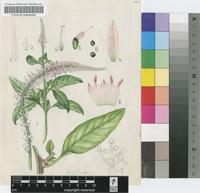
Hermbstaedtia scabra Schinz [family AMARANTHACEAE], in Verh. Bot. Ver. Prov. Brand. 31: 209 (1809).—Baker & Clarke in F.T.A. 6, 1: 28 (1909). TAB. 9 fig. C. Type from Namibia.
Celosia scabra Schinz Schinz [family AMARANTHACEAE], in Engl. & Prantl Pflanzenfam. 3 1a: 100 (1893); in ed. 2, 16 C: 30 (1934).—Meeuse in Kirkia 2: 157 (1961).—Podlech & Meeuse in Merxm. Prodr. Fl. SW. Afr. 33: 13 (1966).
Information
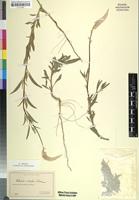
Erect annual herb, 0.5–1.1 m. tall, simple to considerably branched with long ascending branches. Stem and branches terete to bluntly quadrangular, striate, moderately to densely furnished with pale to yellowish multicellular hairs. Leaves lanceolate or narrowly elliptic, those of the main stem 1.4–9 × 0.4–1.5 (2.5) cm., attenuate below or in broader-leaved forms with a petiole up to 1.2 cm. long, obtuse to subacute, the midrib and primary venation of the inferior surface together with the margins more or less furnished (usually more or less densely) with divergent scabrid hairs, surfaces with softer multicellular hairs; superior and branch leaves rapidly smaller and narrower, small-leaved axillary shoots commonly present. Inflorescences terminal on the stem and branches, spicate, c. (1.5) 4–30 × 1–1.25 cm., bright rose-pink, the axis densely furnished with multicellular hairs. Bracts lanceolate, 3–5 mm. long, hyaline with a whitish central band, very acute with a shortly excurrent midrib, glabrous or ciliate, sometimes erose-denticulate; bracteoles similar but somewhat shorter and broader. Tepals elliptic-oblong, 4.5–6.5 mm. long, glabrous, the outer with a very shortly excurrent midrib and usually 2 progressively shorter pairs of lateral (one or more of which is sometimes branched), hyaline-bordered; inner tepals similar but slightly narrower and often only 3-nerved. Stamens fused into a tube for c. three quarters or more of their length, c. 1 mm. shorter than the tepals; free apical portions more or less rounded, truncate or slightly emarginate on each side of the antheriferous apex. Ovary c. 6–8-ovulate, conical above; stigmas (2) 3, spreading or recurved and shorter than the slender, 2–4 mm. long, finally more or less exserted style. Capsule c. 5 mm. long, circumcissile with the apex longly and gradually narrowed into the finally exserted style, furnished with more or less colourless unicellular papillose hairs. Seeds c. 1 mm. in diam.
Habitat
On sandy soil in open savanna, in open Mopane woodland, on river banks and in abandoned cultivation
Altitude range
900–1030 m. recorded.
1030
900
Distribution
Zambia S Kazungula, s.d., Gairdner 419 (K).Zimbabwe W Hwange Distr., near Sesheke Pan, c. 11 km. S. of Main Camp, Hwange Nat. Park, 1030 m., 28.ii.1971, Rushworth 2539 (K; SRGH).Zambia W Nangweshi (Cult. ex) Codd 8507 (K; PRE).Botswana N W. bank of Okavango R., 28.iv.1975, Biegel, Müller & Gibbs-Russell 5033A IK; SRGH).
Distribution (external)
Namibia

Related Materials

  • Terms and Conditions
  • Privacy Policy
  • Cookie Policy
  • Cookie Settings
  • Accessibility
  • Help
  • Contact Us
  • Facebook
  • Twitter
ITHAKA

JSTOR is part of ITHAKA, a not-for-profit organization helping the academic community use digital technologies to preserve the scholarly record and to advance research and teaching in sustainable ways.

©2000-2026 ITHAKA. All Rights Reserved. JSTOR®, the JSTOR logo, JPASS®, Aluka®, and ITHAKA® are registered trademarks of ITHAKA.

╳