JSTOR Global Plants Home
  • Home
  • Browse
  • About
  • Access
  • Account
    • Saved Items
    • Profile
  • Log in

Global Plants

Skip to Main Content
  • JSTOR Global Plants Home
  • Global Plants

    • Browse
    • About
    • Access
    • Account
      • Saved Items
      • Profile
Log in
  • Browse
  • About
  • Access
  • Account
    • Saved Items
    • Profile
Advanced Search

Compilation
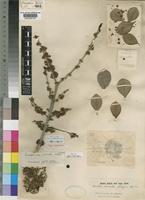
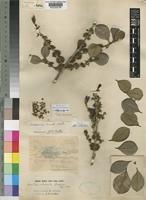
Cassipourea obovata

2 Images see all

Cassipourea obovata Alston [family RHIZOPHORACEAE]
Previous
Next

Name

Identification
Cassipourea obovata Alston [family RHIZOPHORACEAE ] (stored under name); Verified by Alston, A.H.G., Weihea obovata Sprague [family RHIZOPHORACEAE ]
Related name
  • Weihea obovata
  • Cassipourea obovata

Flora

Entry for Cassipourea obovata Alston [family RHIZOPHORACEAE]
Herbarium
Royal Botanic Gardens, Kew (K)
Collection
Flora Zambesiaca
Resource Type
Reference Sources
Entry From
FZ, Vol 4, Part 0, page 81, (1978) Author: A. R. Torre and A. E. Gonçalves
Names
Cassipourea obovata Alston [family RHIZOPHORACEAE], in Kew Bull. 1925: 261 (1925). Type: Mozambique, Cabo Delgado Distr., Macomia, near mouth of Msalu (Messalo) R., Allen 89 (2 specimens) (K, syntypes).
Information
Tree 6 m. high; branches pale grey, rough, pubescent when young, glabrous with age. Leaf-lamina 3–5 x 1·8–3·5 cm., obovate, leathery; apex rounded, truncate, obtuse or shortly acuminate and refuse at its extremity; margins entire and somewhat revolute; base cuneate to ± attenuate into the petiole; midrib straight, prominent below, and reticulation slightly prominent on both surfaces; superior surface glabrous; inferior surface very sparsely appressed-pubescent (except along the midrib); petiole 3–5 mm. long, glabrous or glabrescent; stipules 3 mm. long, broadly ovate, rounded at the apex and subcordate-truncate at the base, externally glabrescent or glabrous (pubescent towards the apex). Inflorescences ± dense and congested fascicles. Flowers 5–6-merous; pedicels 1·5–2 mm. long, ± pubescent, articulate near the apex; bracteoles c. 1·5 mm. long, ± conchiform, truncate or rounded (sometimes lacerate) at the apex, truncate at the base, glabrous or glabrescent abaxially and puberulous at the margins. Calyx appressed-pubescent outside and glabrous inside; calyx-tube c. 1 mm. long; calyx-lobes 4–5 mm. long, lanceolate. Petals c. 5 mm. long, spathulate, laciniate above, glabrous. Stamens c. 17; filaments 3–4 mm. long; anthers c. 1 mm. long, oblong-ellipsoid. Ovary 1·5 mm. long, ovoid, 3–4-locular, sparsely hairy (more densely towards the apex), semi-inferior; style 3–4 mm. long, hairy at and near the base, persistent, with 3–4 stigmatic surfaces at the apex. Fruit unknown, stated to be edible.
Habitat
growing on sandy hills
Range
Known only from the type collection
Altitude range
near the sea
100
0
Distribution
Mozambique N Cabo Delgado Distr., Macomia, near mouth of Msalu (Messalo) R., fl. xii.1911, Allen 89 (K).

Related Materials

  • Terms and Conditions
  • Privacy Policy
  • Cookie Policy
  • Cookie Settings
  • Accessibility
  • Help
  • Contact Us
  • Facebook
  • Twitter
ITHAKA

JSTOR is part of ITHAKA, a not-for-profit organization helping the academic community use digital technologies to preserve the scholarly record and to advance research and teaching in sustainable ways.

©2000-2026 ITHAKA. All Rights Reserved. JSTOR®, the JSTOR logo, JPASS®, Aluka®, and ITHAKA® are registered trademarks of ITHAKA.

╳