

Compilation
Cassipourea elliottii
1 Images see all
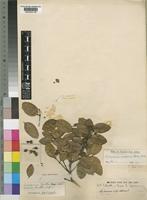
Name
Identification
Cassipourea elliottii Alston [family RHIZOPHORACEAE ] Verified by Alston, A.H.G., Cassipourea malosana Alston [family RHIZOPHORACEAE ] (stored under name); Verified by Lewis, J.,
Related name
- Cassipourea malosana
- Cassipourea elliottii
Flora
Entry for Cassipourea malosana (Baker) Alston [family RHIZOPHORACEAE]
Herbarium
Royal Botanic Gardens, Kew (K)
Collection
Flora of Tropical East Africa
Resource Type
Reference Sources
Entry From
Flora of Tropical East Africa, page 1, (1956) Author: JOHN LEWIS
Names
Cassipourea malosana (Baker) Alston [family RHIZOPHORACEAE], in K.B. 1925: 258 (1925); J. Lewis in K.B. 1955: 144 (1955). Type: Nyasaland, Mt. Malosa, Whyte (K, holo.!)
Weihea malosana Baker [family RHIZOPHORACEAE], in K.B. 1897: 267 (1897)
Weihea elliottii Engl. [family RHIZOPHORACEAE], in E.J. 40: 52 (1907). Type: Kenya, Nairobi District: Mosigi, Elliott 145 (K, iso.!)
Weihea eickii Engl. [family RHIZOPHORACEAE], in E.J. 40: 50 (1907). Types: Tanganyika, W. Usambaras, plateau near Kwai, Albers 198, 19 & Eick 137 (B, syn. †; BM & K, photosyn.!); Drummond & Hemsley 1353 (K, EA, neo.!)
Weihea ilicifolia v. Brehm. [family RHIZOPHORACEAE], in E.J. 54: 362 (1917). Type: Tanganyika, Mfimbwa Mt., Fromm 230 & 232 (B, syn. †)
Cassipourea eickii (Engl.) Alston [family RHIZOPHORACEAE], in K.B. 1925: 259 (1925); T.T.C.L. 472 (1949)
Cassipourea elliottii (Engl.) Alston [family RHIZOPHORACEAE], in K.B. 1925: 260, & fig. 243 (1925); I.T.U., 2nd ed., 330 (1952); T.T.C.L. 472 (1949)
Weihea wambugensis Engl. [family RHIZOPHORACEAE], [in V.E. 3 (2): 669 (1921). Type: from Tanganyika, W. Usambaras, Wambuguland (B, †) nom. nud.]
Information
Evergreen tree (6–) 12–45 m. tall; young stem ± appressed-pubescent, glabrescent (first year stem scattered-hirsute). Leaves petiolate; petiole 3–8 mm. long, indumentum similar to stem; blade narrowly to almost broadly elliptic or more rarely obovate, usually c. 5 × 3 cm., exceptionally c. 10 × 5 cm., cuneate or subrounded to an acute base, shortly to longly acuminate or rarely rounded, extreme apex very usually obtuse, margin ± widely bluntly or sharply serrate, especially above, to rarely entire, glabrous above, ± sparsely and obscurely appressed-pubescent beneath especially on the midrib, hairs thin, lying regularly in the direction of the apex, glabrescent, papery to chartaceous. Flowers 1–5 (–8) per inflorescence; pedicels up to 4 mm., rarely 7 mm. long, articulate above the middle, densely puberulous. Calyx 4–5 (–6)-partite; tube 1 mm. long; lobes 3.5–5 mm. long, narrowly oblong-triangular, apex acute, densely appressed-pubescent externally, glabrous or very nearly so within. Petals 4–5, laciniate apically. Stamens (15–) 16–20 (–22), arising from the margin of a very short disc; anthers introrse. Ovary superior, 3 (–4)-celled, glabrous or almost so with a few apical hairs to longly hirsute especially towards the apex; style persistent. Capsule ovoid, 6.5–8 mm. long, shortly appressed-pubescent especially above the middle, with longer upright hairs apically, glabrescent, rarely glabrate. Capsule longer than the persistent style.
Range
DISTR. U1; K1, 3–6; T2, 3, 7
Altitude range
(1100–) 1700–2600 m.
Distribution
KENYA Baringo District Katimok forest, Oct. 1930, Dale 2452!;KENYA Kiambu District Chania Forest, 28 Nov. 1942, Logie in Bally 7968!;KENYA Masai District Ngong Forest, Bally 6529! & Moon 21!TANGANYIKA Masai District SE. slope of Ngorongoro crater, 22 Feb. 1933, Greenway 3369!;TANGANYIKA Arusha District Mt. Meru, July 1951, Parry 65!;TANGANYIKA Iringa District Ihangana Forest Reserve, 23 Aug. 1937, Pitt[-Schenkel] 561!UGANDA Karamoja District Mt. Debasien, Eggeling 2727!;UGANDA Acholi District SE. Imatong Mts., headwaters of Aringa R., 7 Apr. 1945, Greenway & Hummel 7302!
Distribution (external)
; Somaliland Protectorate
Ethiopia
Notes
VARIATION. The North East African material of this species, previously segregated as C. abyssinica, C. avettae and C. salvago-raggei [see K.B. 1955: 144 (1955)], shows a tendency to include specimens with narrower more acuminate leaves; material from Uganda is similar. Kenya material is usually small-leaved (terminal sprigs may bear leaves up to only 4–5 mm. long), the leaves having scarcely any acumen. These differences are not absolute however and the variation in the degree of serration of the leaf margin is not correlated with them. More material would be welcomed from south of latitude 5° S. C. malosana is an important timber tree in East Africa. It has very hard wood of good colour and is referred to in the native vernacular as “Muzaizi.”