JSTOR Global Plants Home
  • Home
  • Browse
  • About
  • Access
  • Account
    • Saved Items
    • Profile
  • Log in

Global Plants

Skip to Main Content
  • JSTOR Global Plants Home
  • Global Plants

    • Browse
    • About
    • Access
    • Account
      • Saved Items
      • Profile
Log in
  • Browse
  • About
  • Access
  • Account
    • Saved Items
    • Profile
Advanced Search

Compilation
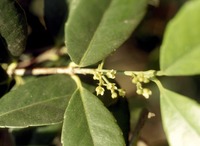
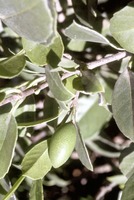
Cassine papillosa

6 Images see all

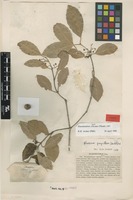
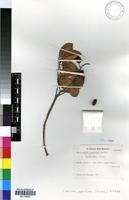
Cassine papillosa (Hochst.) Kuntze
Type of Elaeodendron capense Eckl. & Zeyh. [family CELASTRACEAE]
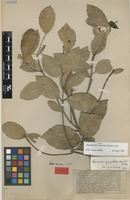
Cassine papillosa (Hochst.) Kuntze
Type of Elaeodendron capense Eckl. & Zeyh. [family CELASTRACEAE]
Isotype of Cassine papillosa (Hochst.) Kuntze [family CELASTRACEAE]
Cassine papillosa (Hochst.) Kuntze
Previous
Next

Name

Identification
Isotype of Cassine papillosa (Hochst.) Kuntze [family CELASTRACEAE ] Verified by Not on sheet, Elaeodendron croceum (Thunb.) DC. [family CELASTRACEAE ] (stored under name); Verified by Not on sheet,
Related name
  • Elaeodendron croceum
  • Cassine papillosa
  • Elaeodendron capense

Flora

Entry for Elaeodendron capense Eckl. & Zeyh. [family CELASTRACEAE]
Herbarium
Royal Botanic Gardens, Kew (K)
Collection
Flora Zambesiaca
Resource Type
Reference Sources
Entry From
FZ, Vol 2, Part 2, page 355, (1966) Author: N. K. Robson
Names
Elaeodendron capense Eckl. & Zeyh. [family CELASTRACEAE], Enum. Pl. Afr. Austr. Extratrop. 1: 127 (1834–35?). — Grah. in Curt. Bot. Mag. 67: t. 3835 (1841). — Sond. in Harv. & Sond., F.C. 1: 468 (1860). — Bak. f. in Journ. Linn. Soc., Bot. 40: 45 (1911). — Eyles in Trans. Roy. Soc. S. Afr. 5: 404 (1916). — Marloth, Fl. S. Afr. 2, 2: 154, t. 51 fig. E (1925). — Loes. in Engl. & Prantl, Nat. Pflanzenfam., ed. 2, 20b: 173 (1942). Type from S. Africa (Cape Prov.).
Elaeodendron papillosum Hochst. [family CELASTRACEAE], in Flora, 27: 305 (1844). Type from Natal.
Cassine papillosa Hochst. Kuntze [family CELASTRACEAE], Rev. Gen. Pl. 1: 114 (1891). — Davison in Bothalia, 2: 334 (1927) pro parte excl. syn. C. lacinulata Loes. Type as for Elaeodendron papillosum.
Information
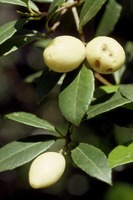
Tree 2·5–10·5 in. high; branches 4-lined, flattened and pale grey-green to vinous red when young, becoming terete and grey-brown with prominent blackish lenticels. Leaves with lamina greyish-green above, concolorous, 5·3–11·5(15·8) × 2·1–4·4(6·7) cm., oblong to elliptic, acute or very shortly acuminate to obtuse at the apex, with margin indurated, shortly spinulose-denticulate to obtusely glandular-denticulate on flowering shoots, spreading-spinose-dentate on juvenile shoots, cuneate at the base, coriaceous, with densely to rather laxly reticulate venation equally prominent on both sides; petiole 5–11 mm. long. Cymes in axil of bract-like prophylls at base of current year’s shoot, rarely also in axil of lowermost foliage leaf; peduncle (2)3–16 mm. long; flowers (1)3–7 in each dichasium, 4–5 mm. in diam., bisexual. Sepals 4, all c. 1 mm. long or inner pair shorter, ovate-oblong, rounded, entire. Petals 4, green to yellow, 1·5–2 mm. long, ovate to oblong, entire. Stamens 4. Disk slightly 4-lobed, with lobes shallowly emarginate, flat, glabrous. Ovary 2-locular, almost completely immersed in the disk except for the style. Drupe yellow, drying dark red, c. 20 mm. long, ovoid to broadly ovoid, smooth or with a few emergences (“papillae”). Seed 1.
Habitat
Medium altitude evergreen forest
Range
From S. Rhodesia to eastern Cape Prov.; introduced into St. Helena
Altitude range
1100–1980 m. in our area.
1980
1100
Distribution
Zimbabwe E Umtali, Inyamatshira Mts., 1525 m., fr. 9.ix.1951, Chase 3944 (BM; COI; K; LISC; SRGH).
Notes
The above description refers to the S. Rhodesian specimens only. The Natal and Cape Prov. plants tend to have smaller flowers and narrower fruits; but, until fruiting material is collected in the Transvaal, it will not be possible to say whether or not the two populations are subspecifically distinct.

Related Materials

  • Terms and Conditions
  • Privacy Policy
  • Cookie Policy
  • Cookie Settings
  • Accessibility
  • Help
  • Contact Us
  • Facebook
  • Twitter
ITHAKA

JSTOR is part of ITHAKA, a not-for-profit organization helping the academic community use digital technologies to preserve the scholarly record and to advance research and teaching in sustainable ways.

©2000-2026 ITHAKA. All Rights Reserved. JSTOR®, the JSTOR logo, JPASS®, Aluka®, and ITHAKA® are registered trademarks of ITHAKA.

╳