

Compilation
Cassia zanzibarensis
1 Images see all
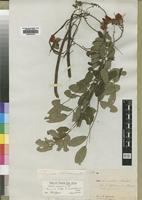
Name
Identification
Isotype of Cassia zanzibarensis Vatke [family LEGUMINOSAE ] Verified by Brenan,J.P.M., Cassia singueana Delile [family LEGUMINOSAE ] (stored under name); Verified by Brenan,J.P.M.,
Related name
- Cassia zanzibarensis
- Cassia singueana
Flora
Entry for CASSIA singueana Del. [family LEGUMINOSAE-CAESALPINIOIDEAE]
Herbarium
Royal Botanic Gardens, Kew (K)
Collection
Flora of Tropical East Africa
Resource Type
Reference Sources
Entry From
Flora of Tropical East Africa, page 1, (1967) Author: J. P. M. Brenan
Names
CASSIA singueana Del. [family LEGUMINOSAE-CAESALPINIOIDEAE], Cent. Pl. Afr.: 28 (1826); Del. in Caillaud, Voy. à Méroé 4: 27 (1827); T.T.C.L.: 98 (1949); I.T.U., ed. 2: 60, t. 4 (1952); Steyaert in F.C.B. 3: 509 (1952); Mendonça & Torre in C.F.A. 2: 179 (1956); K.T.S.: 102, t. 8 (1961); F.F.N.R,: 120 (1962). Type: Ethiopia, Singué [Jebel Singel, Caillaud (MPU, holo.)
CASSIA goratensis Fres. [family LEGUMINOSAE-CAESALPINIOIDEAE], in Flora 22: 53 (1839); L.T.A.: 634 (1930); T.S.K.: 61 (1936). Type: Ethiopia, Rueppell (FR, holo.)
CASSIA zanzibarensis Vatke [family LEGUMINOSAE-CAESALPINIOIDEAE], in Oesterr. Bot. Zeitschr. 30: 77 (1880); L.T.A.: 635 (1930); T.T.C.L.: 99 (1949). Type: Tanganyika, Bagamoyo District, R. Wami and R. Kingoni, Hildebrandt 904 (B, holo.†, BM, iso. !)
CASSIA goratensis Bak. f. var. glabra [family LEGUMINOSAE-CAESALPINIOIDEAE], L.T.A.: 634 (1930). Types: no specimens cited
CASSIA goratensis Bak. f. var. flavescens [family LEGUMINOSAE-CAESALPINIOIDEAE], L.T.A.: 634 (1930). Types: Tanganyika, Tanga District, Misoswe (Mizozue), Holst 2225 (K, syn. !) & Tanganyika, without locality, Busse 169 (BM, syn. !, K, isosyn. !) & Busse 392 (BM, syn. !, K, isosyn. !)
CASSIA singueana (Bak. f.) Brenan var. glabra [family LEGUMINOSAE-CAESALPINIOIDEAE], in K.B. 4: 77 (1949); T.T.C.L.: 99 (1949)
CASSIA singueana (Bak. f.) Brenan var. flavescens [family LEGUMINOSAE-CAESALPINIOIDEAE], in K.B. 4: 77 (1949); T.T.C.L.: 98 (1949)
Information
Shrub or small tree 1–15 in. high. Branchlets glabrous to densely pubescent. Leaves: petiole eglandular (i.e. without conspicuous glands—minute reddish ones may be present); rhachis with a conspicuous fusiform or stipitate gland between each pair of leaflets except often the terminal. Stipules subulate, caducous, 0.5–0.75 mm. wide. Leaflets (5–)6–10(–12) pairs, elliptic, oblong-elliptic or obovate-elliptic, (1.5–)2.5–6.3(–7.5) cm. long, (0.7–)1.4–2.7(–3) cm. wide, rounded and often emarginate at apex, rarely subacute, glabrous or nearly so to densely pubescent. Racemes 6- to many-flowered, usually pedunculate and ± corymbose, often aggregated towards branchlet-ends and often produced when the plant is leafless; their axes bear conspicuous glands similar to those on the leaf-rhachides. Flowers yellow, hermaphroditeor sometimes ♀ (without stamens). Pedicels 2.2–4(–5) cm. long. Sepals rounded at apex. Petals obovate to suborbicular, 1.5–3(–3.5) cm. long. Stamens: 3 lower with large anthers and long filaments; 4 with somewhat shorter anthers and short filaments; 3 upper with reduced anthers. Pods linear, straight or somewhat twisted, torulose, subcylindric or slightly compressed, 5.5–26 cm. long, 0.7–1.0 cm. wide, indehiscent, with stiff and rather hard valves, glabrous to ± pubescent, rounded to abruptly acute and often apiculate at apex. Seeds dull brown, almost circular, flattened, ± 5–6 mm. in diameter, with a small areole 2–2.5 × 1–1.5 mm. on each face. Fig. 13, p. 74.
Range
DISTR. U1, 3; K1, ?2, 3–5, 7; T1–8 widespread in tropical Africa, except in the rainforest regions; also on the Comoro Is.
Altitude range
near sea-level to 2130 m.
Distribution
KENYA Northern Frontier Province Balambala, 23 Jan. 1943, Bally 2181 !KENYA Kiambu District Theta road, 5 July 1952, Kirrika 199 !KENYA Kwale District Shimba Hills, Mwele Mdogo Forest, 6 Feb. 1953, Drummond & Hemsley 1149 !TANGANYIKA Shinyanga, 11 Oct. 1949, Windisch-Graetz in Bally 7578 !TANGANYIKA about 8 km. S. of Dodoma, 19 July 1956, Milne-Redhead & Taylor 11180!TANGANYIKA Rungwe District Kyimbila, 19 Dec. 1913, Stolz 2393 !UGANDA Acholi District Padibe, Apr. 1943, Purseglove 1354!UGANDA Karamoja District Warr, 4 Nov. 1939, A. S. Thomas 3159!UGANDA Teso District Serere, Dec. 1931, Chandler 347!
Notes
VARIATION. C. singueana shows a wide range of variation which is difficult to analyse clearly. It appears that characters such as presence or lack of indumentum, number, size and shape of leaflets and size of flowers are varying to some extent independently. Specimens from a single region often look similar, but may pass by perplexing intermediates into a different variant occupying an adjacent region. Furthermore the same or similar variants may occur in regions widely separated geographically. It seems therefore preferable not to recognize any named infraspecific taxa, but to attempt a general simplified account of what occurs in East Africa.In Uganda forms prevail with comparatively short leaflets about 2–4 cm. long and up to or slightly more than twice as long as wide. Their general shape is elliptic, with their greatest breadth about the middle, but less commonly tendencies to an obovate or slightly ovate shape may be shown. The indumentum on the leaflets varies from densely pubescent to almost glabrous. The inflorescence axes are ± grey-pubescent and the sepals ± so outside.In inland Kenya forms occur similar to those of Uganda, and these extend to the coast. There, however, a rather distinctive variant also occurs, with rather long elliptic leaflets up to 6 cm. in length and usually more than twice as long as broad and the indumentum on the outside of the sepals characteristically dense, conspicuous and yellowish (var. flavescens, see above).This variant also extends along the coast of Tanganyika. A specimen of this variant, Hughes 240, from Tanganyika, Tanga District, Same-Gonja road, has valuable on the bark, which is there stated to be medium-grey, smooth, marked with characteristic broadly obtriangular lenticels 0.6 cm. long, slight vertical ridges and from time to time marked horizontal ones. It is at present uncertain if these characters are shown also by the other variants of C. singueana. Inland in Tanganyika two other principal forms occur, one with densely pubescent short obovate leaflets which is found in Kenya also, and a glabrous one in southwestern Tanganyika (var. glabra, see above) which is scarcely separable from similar but apparently infrequent forms in Kenya and Uganda.