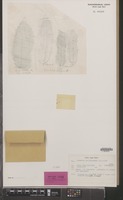
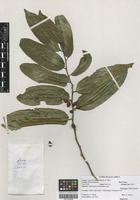
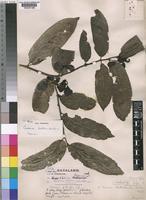
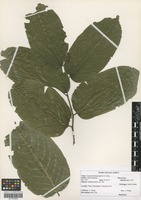
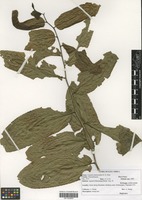
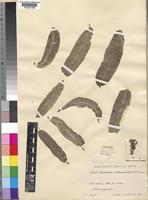
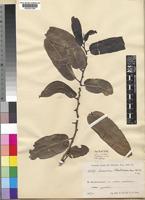
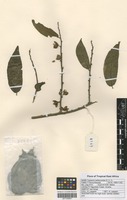
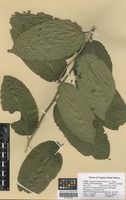
Small or medium-sized tree with horizontally straggling branches, or generally a tall forest tree up to 40 m. high and with straight, sometimes fluted bole 30–45(–90) cm. in diameter and a vertical crown; bark rough, grey to brownish, or almost dark on old trees, peeling off in ± rectangular thin patches. Branchlets usually puberulous, glabrescent, silvery in saplings. Leaf-blade oblong or narrowly oblong, (8–)12–22 cm. long, 3–5(–7) cm. wide, generally rather unequal-sided, shortly obtusely acuminate or obtuse, base cuneate to rounded on one, and rounded on the other side, or subcordate, glabrous, or fugaciously hairy beneath, firmly chartaceous to subcoriaceous, subentire or (especially on saplings) subserrate-crenulate or undulate, and with (12–) 14–20 pairs of rather irregular curved secondary veins, these ± prominent beneath, reticulation but slightly raised beneath; petiole 6–10(–15) mm., glabrous or puberulous. Flowers numerous, hairy, greenish-yellowish, in axillary fascicles borne on a cushion of minute pubescent bracts; pedicels (2–)3–4 mm. Calyx-lobes ± 2 mm. long. Filaments and anthers very shortly hairy. Fruit subovoid-ellipsoid, slightly angular, 2–4-valved, yellow-orange, 1–1.3 cm. long, ± 0.8 cm. in diameter. Seeds few. Fig. 16/A.