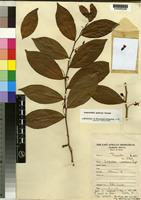
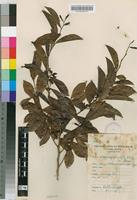
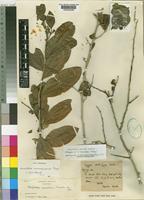
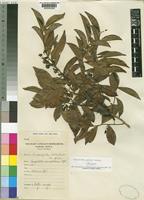
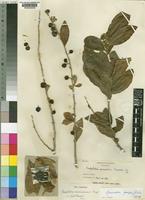
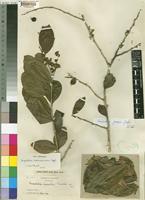
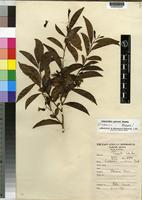
Shrub or small tree up to 5 m tall; branchlets puberulous, glabrescent or glabrous. Stipules absent or visible as a dark, gland-like, glabrous spot, usually elevated or sometimes even conical-truncate, up to 1 mm high. Leaves papery to thinly coriaceous, shortly petiolate, obovate to elliptic or ovate-elliptic, (1.5–)2.5–12(–18)≈(1–)1.5–6(–7.5) cm, acuminate or rounded, obtuse, base rounded or cuneate; upper surface glabrous except for the midrib, sometimes sparsely pubescent below with rather long, reddish-brown hairs on midrib often extending towards the base or leaves entirely glabrous; petiole (1–)1.5–3(–4) mm. Flowers white, cream or yellowish, with purple, red to bright pink honeyguides on tips of the petals; the corolla turns pinkish-brown after fertilization, scented, in axillary racemes (1–3 per axil) up to 3.5 cm long, 2–9-flowered; peduncle 3 mm long, pubescent; rachis pubescent; bracts and bracteoles often soon caducous, triangular, 0.5–1.5(–2) mm long, pubescent or glabrous; the basal ones often sterile and up to 3(–4) mm long. Sepals pale green, broadly ovate-elliptic, (3–)4–10≈(2–)3–6 mm, the largest up to 2 times the smaller, the upper one keel-shaped, the 2 inner ones obtuse or emarginate, glabrous or brownish pubescent outside, more densely towards the base, ciliate. Petals subequal in size, (10–)12–15(–18)≈2–4(–5) mm, the median one narrowly obovate-spathulate, gradually tapering into the claw, the inner ones oblong-elliptic, puberulous outside, ciliate. Stamens (7–)9–12 mm long; anthers 1 mm long. Fruit ovoid-subglobose, (1–)1.5(–2) cm in diameter, usually lobed, 1–3-seeded. Seeds ellipsoid, flattened, 7–9(–10)≈3–6(–7.5) mm, covered with silky rusty brownish hairs. Fig. 1, p. 2.