Global Plants
Skip to Main Content
Global Plants
Browse
About
Access
Account
Saved Items
Profile
Log in
Browse
About
Access
Account
Saved Items
Profile
Filter search by
Names
Names with Synonyms
Places
People
Free Text
Search
Search
Advanced Search
Compilation
Carex sheldonii
2 Images
see all
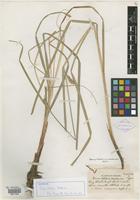
Isotype of Carex sheldonii Mack. [family CYPERACEAE]
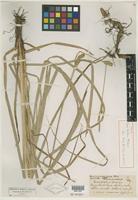
Type of Carex sheldonii Mack. [family CYPERACEAE]
Previous
Next
Name
Identification
Carex sheldonii
Mack.
[family
CYPERACEAE
] (stored under name); Verified by K. K. Mackenzie,
Related name
Carex sheldonii
Flora
Entry for Carex sheldonii Mackenzie [family CYPERACEAE]
Herbarium
Flora of North America (FNA)
Collection
Flora of North America
Resource Type
Reference Sources
Entry From
Flora of North America, Vol 23,
Names
Carex sheldonii
Mackenzie
[family
CYPERACEAE
], Bull. Torrey Bot. Club, 42: 618. 1915
Treatment Author(s)
Peter W. Ball
A. A. Reznicek
Information
Culms trigonous in cross section, 40–80 cm. Leaves: basal sheaths reddish purple, inner bands slightly fibrillose with age; sheaths pubescent, at least at apex of inner band; ligules 2–9 mm; blades 2.5–6 mm wide, finely spreading-pubescent or glabrous, not papillose abaxially. Inflorescences 15–50 cm; spikes erect or ascending; proximal (1–)2–3 spikes pistillate; terminal 1–4 spikes staminate. Pistillate scales narrowly ovate, apex acute to acuminate, scabrous-awned, scabrous near midrib, otherwise glabrous. Staminate scales lanceolate to narrowly ovate, apex obtuse to acuminate, awnless, glabrous or sparsely ± appressed-pubescent near apex. Perigynia 12–18-veined, 4.8–6.5 × 1.4–2.4 mm, sparsely to densely pubescent; beak 1.4–2.6 mm, pubescent, teeth spreading, (0.4–)0.6–1.4 mm.
Phenology Fruiting
jun
summer
jul
aug
sep
fall
Altitude range
1200–1900 m;
Distribution
USA Calif.USA IdahoUSA Nev.USA Oreg.
Related Materials
╳