JSTOR Global Plants Home
  • Home
  • Browse
  • About
  • Access
  • Account
    • Saved Items
    • Profile
  • Log in

Global Plants

Skip to Main Content
  • JSTOR Global Plants Home
  • Global Plants

    • Browse
    • About
    • Access
    • Account
      • Saved Items
      • Profile
Log in
  • Browse
  • About
  • Access
  • Account
    • Saved Items
    • Profile
Advanced Search

Compilation
Carex pigra

5 Images see all

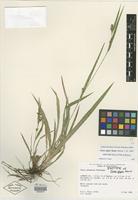
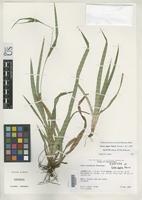
Isotype of Carex pigra Naczi [family CYPERACEAE]
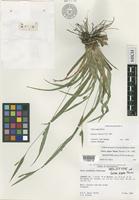
Holotype of Carex pigra Naczi [family CYPERACEAE]
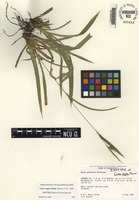
Isotype of Carex pigra Naczi [family CYPERACEAE]
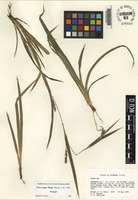
Paratype of Carex pigra Naczi [family CYPERACEAE]
Isotype of Carex pigra Naczi, R.F.C. 1997 [family CYPERACEAE]
Previous
Next

Name

Identification
Carex pigra Naczi [family CYPERACEAE ] (stored under name); Verified by R.K. Rabeler, 1998 Carex pigra Naczi [family CYPERACEAE ] Verified by Not on sheet,
Related name
  • Carex pigra

Flora

Entry for Carex pigra Naczi [family CYPERACEAE]
Herbarium
Flora of North America (FNA)
Collection
Flora of North America
Resource Type
Reference Sources
Entry From
Flora of North America, Vol 23,
Names
Carex pigra Naczi [family CYPERACEAE], Novon, 7: 67, fig. 1. 1997
Treatment Author(s)
Peter W. Ball
A. A. Reznicek
Information
Plants densely cespitose; rhizome internodes 1.2–2.8 mm thick. Culms yellow-brown at base, 10–50 cm. Leaves: sheaths glabrous; blades glaucous, widest blades 6.1–12.3 mm wide, smooth abaxially. Inflorescences 0.71–0.93 of culm height, rarely all spikes separate, peduncles of lateral spikes smooth, 0.4–11 cm; peduncles of terminal spikes 1.5–37(–62) mm, usually overlapping or shorter than distal lateral spike; proximal bract sheath loose, abaxially glabrous, sheath front slightly convex, elongated 0.2–2.2 mm beyond apex; ligules (3–)5.2–10.2 mm; distal bract slightly shorter than to much exceeding terminal spike. Spikes (3–)4–6, usually distal 2–3 overlapping; lateral spikes pistillate, longest ones with 11–25(–28) perigynia, 8–32 × 3.3–6.1(–6.8) mm, ratio of spike length (in mm) to flower number = (0.97–)1–1.3(–1.6); terminal spikes 6–32 × 1.8–3.3 mm. Pistillate scales 1.9–3.2(–4.5) × 1.3–2.2 mm, margins pale ferrugineous to whitish, entire, apex with awn 0.1–0.9(–1.9) mm. Staminate scales (3.9–)4.5–5.3 × 1.6–2 mm. Anthers 1.6–2.6 mm. Perigynia spirally imbricate, 42–56-veined, unwrinkled, narrowly ovoid, (3.7–)3.9–4.5(–4.7) × 1.5–2.2 mm, (1.9–)2.1–2.6(–2.8) times as long as wide, obtusely triangular in cross section, dull, base gradually tapered, apex gradually tapered; beak absent or straight, 0–0.2(–0.4) mm. Achenes obovoid, 2.6–3.1 × (1.3–)1.4–1.6 mm, 0.5–0.63 times as long as perigynia, loosely enveloped by perigynia; stipe straight, 0.1–0.3(–0.5) mm; beak bent (0–)30–90°, (0.1–)0.2–0.4(–0.5) mm.
Phenology Fruiting
spring
mar
apr
may
Altitude range
0–300 m;
Distribution
USA Ala.USA Fla.USA Ga.USA Miss.USA N.C.USA S.C.USA Tenn.USA Va.
Discussion
Carex pigra often associates with C. blanda and C. planispicata. The ranges of C. pigra, C. flaccosperma, and C. glaucodea overlap, although C. pigra is not commonly sympatric with those species. When growing with C. flaccosperma, C. pigra usually inhabits slightly drier sites, and when growing with C. glaucodea, C. pigra usually inhabits slightly moister sites. Carex pigra does not appear to form hybrids with either C. flaccosperma or C. glaucodea.

Related Materials

  • Terms and Conditions
  • Privacy Policy
  • Cookie Policy
  • Cookie Settings
  • Accessibility
  • Help
  • Contact Us
  • Facebook
  • Twitter
ITHAKA

JSTOR is part of ITHAKA, a not-for-profit organization helping the academic community use digital technologies to preserve the scholarly record and to advance research and teaching in sustainable ways.

©2000-2026 ITHAKA. All Rights Reserved. JSTOR®, the JSTOR logo, JPASS®, Aluka®, and ITHAKA® are registered trademarks of ITHAKA.

╳