JSTOR Global Plants Home
  • Home
  • Browse
  • About
  • Access
  • Account
    • Saved Items
    • Profile
  • Log in

Global Plants

Skip to Main Content
  • JSTOR Global Plants Home
  • Global Plants

    • Browse
    • About
    • Access
    • Account
      • Saved Items
      • Profile
Log in
  • Browse
  • About
  • Access
  • Account
    • Saved Items
    • Profile
Advanced Search

Compilation
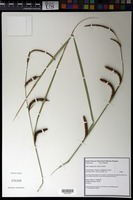
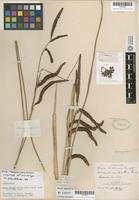
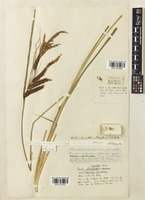
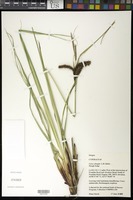
Carex obnupta

6 Images see all

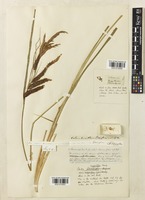
Carex obnupta L.H. Bailey [family CYPERACEAE]
Isosyntype of Carex obnupta L. H. Bailey [family CYPERACEAE]
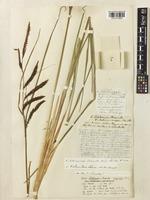
Carex obnupta L.H.Bailey [family CYPERACEAE]
Carex obnupta L.H. Bailey [family CYPERACEAE]
Carex obnupta L.H.Bailey [family CYPERACEAE]
Previous
Next

Name

Identification
Carex obnupta L. H. Bailey [family CYPERACEAE ] (stored under name); Verified by Not on sheet,
Related name
  • Carex obnupta

Flora

Entry for Carex obnupta L. H. Bailey [family CYPERACEAE]
Herbarium
Flora of North America (FNA)
Collection
Flora of North America
Resource Type
Reference Sources
Entry From
Flora of North America, Vol 23,
Names
Carex obnupta L. H. Bailey [family CYPERACEAE], Proc. Calif. Acad. Sci., ser., 2, 3: 104. 1891
Carex magnifica Dewey ex Piper [family CYPERACEAE]
Treatment Author(s)
Peter W. Ball
A. A. Reznicek
Information
Plants not cespitose. Culms obtusely or acutely angled, 20–120 cm, glabrous. Leaves: basal sheaths red-brown; sheaths of proximal leaves bladeless, scabrous, fronts with red-brown spots, prominently ladder-fibrillose, apex U-shaped, red-brown; blades hypostomic, 3–7 mm wide, coriaceous, papillose abaxially. Inflorescences: proximal bract longer than inflorescence, 3–6 mm wide. Spikes arching, at least the proximal pendent; staminate 2–3(–5); pistillate 2–5; proximal pistillate spike usually sessile, 2.5–15 cm × 5–10 mm, base attenuate. Pistillate scales red-brown, longer and wider than perigynia, apex acute, awnless. Perigynia divergent, brown, veinless, somewhat inflated, loosely enclosing achenes, ellipsoid or obovoid, 2.2–3.8 × 1.4–2.2 mm, leathery, glossy, apex rounded, glabrous; beak colorless or with red-brown spots, 0.1–0.3 mm, orifice hyaline. Achenes often constricted on 1 or both margins, glossy; style base often bent. 2n = 70, 72, 74.
Phenology Fruiting
jul
summer
aug
Altitude range
0–900 m;
Distribution
USA Calif.USA Oreg.USA Wash.Canada B.C.
Discussion
Carex obnupta largely replaces C. barbarae north of California and is distinguished from it by the acute scales and the glossy dark brown perigynia that lack veins and have an entire, membranous beak. It is an abundant, almost weedy, plant.
Carex obnupta occasionally hybridizes with C. nudata.

Related Materials

  • Terms and Conditions
  • Privacy Policy
  • Cookie Policy
  • Cookie Settings
  • Accessibility
  • Help
  • Contact Us
  • Facebook
  • Twitter
ITHAKA

JSTOR is part of ITHAKA, a not-for-profit organization helping the academic community use digital technologies to preserve the scholarly record and to advance research and teaching in sustainable ways.

©2000-2026 ITHAKA. All Rights Reserved. JSTOR®, the JSTOR logo, JPASS®, Aluka®, and ITHAKA® are registered trademarks of ITHAKA.

╳