JSTOR Global Plants Home
  • Home
  • Browse
  • About
  • Access
  • Account
    • Saved Items
    • Profile
  • Log in

Global Plants

Skip to Main Content
  • JSTOR Global Plants Home
  • Global Plants

    • Browse
    • About
    • Access
    • Account
      • Saved Items
      • Profile
Log in
  • Browse
  • About
  • Access
  • Account
    • Saved Items
    • Profile
Advanced Search

Compilation
Carex neurophora

4 Images see all

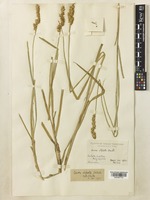
Carex neurophora Mack. [family CYPERACEAE]
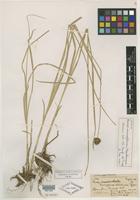
Isotype of Carex neurophora Mack. [family CYPERACEAE]
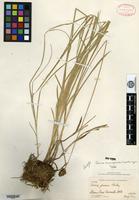
Isotype of Carex neurophora Mackenzie [family CYPERACEAE]
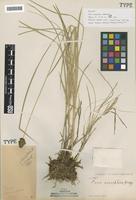
Isotype of Carex neurophora Mack. [family CYPERACEAE]
Previous
Next

Name

Identification
Isotype of Carex neurophora Mackenzie [family CYPERACEAE ] (stored under name); Verified by Mack., 1923
Related name
  • Carex neurophora

Flora

Entry for Carex neurophora Mackenzie [family CYPERACEAE]
Herbarium
Flora of North America (FNA)
Collection
Flora of North America
Resource Type
Reference Sources
Entry From
Flora of North America, Vol 23,
Names
Carex neurophora Mackenzie [family CYPERACEAE], in L. Abrams and R. S. Ferris, Ill. Fl. Pacific States, 1: 298, fig. 706. 1923
Carex vernacula L. H. Bailey var. hobsonii Maguire [family CYPERACEAE]
Treatment Author(s)
Peter W. Ball
A. A. Reznicek
Information
Plants with basal sheaths of previous year not persistent. Culms to 60 cm × 1.5 mm, scabrous. Leaves: sheaths usually all with blades; proximal 2–3 sheaths to 10–15 cm with reduced blades shorter than sheath, green, fronts herbaceous, prominently veined, not splitting, apex truncate, fronts of distal sheaths hyaline, rugose, indistinctly linearly veined, apex colorless, hyaline, convex, entire; ligules obtuse, 1.5 mm, free limb to 0.1 mm; blades not clustered at base, not epistomic, to 40 cm × 5 mm. Inflorescences very condensed, ovoid or shortly cylindric, with 5–10 indistinguishable branches, to 2.5 × 1.5 cm; proximal internode not visible, not more than 3 mm; proximal bract scalelike, inconspicuous. Scales hyaline, brown, distinctly shorter than perigynia. Perigynia pale brown, 9–11-veined abaxially, 5–7-veined adaxially, to 3.5 × 1.5 mm, base distended only slightly proximally, cordate; stipe to 0.2 mm; beak to 2 mm, margins serrulate, apex bidentate, teeth to 0.1 mm. Achenes obovate, to 1.5 × 1 mm; stalk to 0.2 mm; persistent style base cylindric.
Phenology Fruiting
aug
summer
Altitude range
1000–3200 m;
Distribution
USA Colo.USA IdahoUSA Mont.USA Oreg.USA Wash.USA Wyo.

Related Materials

  • Terms and Conditions
  • Privacy Policy
  • Cookie Policy
  • Cookie Settings
  • Accessibility
  • Help
  • Contact Us
  • Facebook
  • Twitter
ITHAKA

JSTOR is part of ITHAKA, a not-for-profit organization helping the academic community use digital technologies to preserve the scholarly record and to advance research and teaching in sustainable ways.

©2000-2026 ITHAKA. All Rights Reserved. JSTOR®, the JSTOR logo, JPASS®, Aluka®, and ITHAKA® are registered trademarks of ITHAKA.

╳