JSTOR Global Plants Home
  • Home
  • Browse
  • About
  • Access
  • Account
    • Saved Items
    • Profile
  • Log in

Global Plants

Skip to Main Content
  • JSTOR Global Plants Home
  • Global Plants

    • Browse
    • About
    • Access
    • Account
      • Saved Items
      • Profile
Log in
  • Browse
  • About
  • Access
  • Account
    • Saved Items
    • Profile
Advanced Search

Compilation
Carex jacobi-peteri

2 Images see all

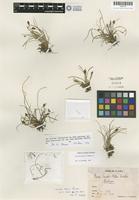
Isotype of Carex jacobi-peteri Hultén [family CYPERACEAE]
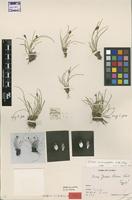
Type of Carex jacobi-peteri Hultén [family CYPERACEAE]
Previous
Next

Name

Identification
Isotype of Carex jacobi-peteri Hultén [family CYPERACEAE ] (stored under name); Verified by Not on sheet,
Related name
  • Carex micropoda
  • Carex jacobi-peteri

Flora

Entry for Carex micropoda C. A. Meyer [family CYPERACEAE]
Herbarium
Flora of North America (FNA)
Collection
Flora of North America
Resource Type
Reference Sources
Entry From
Flora of North America, Vol 23,
Names
Carex micropoda C. A. Meyer [family CYPERACEAE], Mém. Acad. Imp. Sci. St.-Pétersbourg Divers Savans, 1: 210, plate 6. 1831
Carex crandallii Gandoger [family CYPERACEAE]
Carex jacobi-peteri Hultén [family CYPERACEAE]
Carex pyrenaica Wahlenberg subsp. micropoda (C. A. Meyer) Hultén [family CYPERACEAE]
Carex pyrenaica var. mondsii Kelso [family CYPERACEAE]
Treatment Author(s)
Peter W. Ball
A. A. Reznicek
Information
Plants densely cespitose, tuft-forming; rhizomes inconspiuous. Culms 5–30(–40) cm. Leaves involute, 0.25–1.5(–2) mm wide. Pistillate scales light to dark brown, ovate, shorter than to as long as perigynia, apex obtuse to acute, apex and distal margins frequently hyaline, scarious. Perigynia ascending to spreading even reflexed at maturity, light green becoming straw colored, 3–4(–5) (including stipe) × 1–1.3 mm; beak dark brown, much shorter than body of perigynium. Stigmas 2(–3). 2n = 62 (Chukotka).
Phenology Fruiting
jul
summer
aug
Altitude range
10–4000 m;
Distribution
Eurasia (Japan).Eurasia (Russia).USA AlaskaUSA Calif.USA Colo.USA IdahoUSA Mont.USA Nev.USA Oreg.USA UtahUSA Wash.USA Wyo.Canada Alta.Canada B.C. Yukon
Discussion
There is as much variation within the Rocky Mountain Carex crandallii as between C. crandallii and C. micropoda of Alaska and British Columbia. J. A. Calder and R. L. Taylor (1968) reported a weak distinction between a predominately distigmatic coastal race (“micropoda”) and a tristigmatic one (“pyrenaica”) from the interior. T. V. Egorova (1999) illustrated the shapes of perigynia for C. pyrenaica and C. micropoda, and the differences are consistent with what others have noted. Nevertheless, until a more reliable set of characters is found to distinguish these two taxa, all of the North American plants shall be treated as C. micropoda. W. A. Weber and R. C. Wittmann (1992) maintain the North American plants distinct from the European C. pyrenaica at the rank of species, a view that is accepted here. A thorough, worldwide review of relationships among taxa is warranted.

Related Materials

  • Terms and Conditions
  • Privacy Policy
  • Cookie Policy
  • Cookie Settings
  • Accessibility
  • Help
  • Contact Us
  • Facebook
  • Twitter
ITHAKA

JSTOR is part of ITHAKA, a not-for-profit organization helping the academic community use digital technologies to preserve the scholarly record and to advance research and teaching in sustainable ways.

©2000-2026 ITHAKA. All Rights Reserved. JSTOR®, the JSTOR logo, JPASS®, Aluka®, and ITHAKA® are registered trademarks of ITHAKA.

╳