JSTOR Global Plants Home
  • Home
  • Browse
  • About
  • Access
  • Account
    • Saved Items
    • Profile
  • Log in

Global Plants

Skip to Main Content
  • JSTOR Global Plants Home
  • Global Plants

    • Browse
    • About
    • Access
    • Account
      • Saved Items
      • Profile
Log in
  • Browse
  • About
  • Access
  • Account
    • Saved Items
    • Profile
Advanced Search

Compilation
Carex exsiccata

3 Images see all

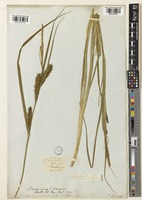
Carex exsiccata L.H.Bailey [family CYPERACEAE]
Type? of Carex exsiccata L.H.Bailey subsp. globosa L.H.Bailey [family CYPERACEAE]
Carex exsiccata L.H.Bailey [family CYPERACEAE]
Previous
Next

Name

Identification
Carex vesicaria L. [family CYPERACEAE ] (stored under name); Verified by Not on Sheet, Carex exsiccata L.H.Bailey [family CYPERACEAE ] Verified by Not on Sheet, Carex vesicaria Not On Sheet [family CYPERACEAE ] Verified by Not on Sheet,
Related name
  • Carex exsiccata
  • Carex vesicaria

Flora

Entry for Carex exsiccata L. H. Bailey [family CYPERACEAE]
Herbarium
Flora of North America (FNA)
Collection
Flora of North America
Resource Type
Reference Sources
Entry From
Flora of North America, Vol 23,
Names
Carex exsiccata L. H. Bailey [family CYPERACEAE], Mem. Torrey Bot. Club, 1: 6. 1889
Carex vesicaria Linnaeus var. major Boott [family CYPERACEAE], in W. J. Hooker, Fl. Bor.-Amer., 2: 221. 1839
Treatment Author(s)
Peter W. Ball
A. A. Reznicek
Information
Plants cespitose; rhizomes short or inconspicuous. Culms trigonous in cross section, 30–100 cm, scabrous-angled distally. Leaves: basal sheaths reddish purple, thickened, not spongy; ligules longer than wide; blades mid to dark green, flat to W-shaped, widest leaves 2.5–6.2 mm wide, smooth adaxially. Inflorescences 10–36 cm; proximal bract 12–55 cm, exceeding but not more than 2.5 times as long as inflorescence; proximal 2–4(–5) spikes pistillate, erect, ca. 20–150-flowered, cylindric; terminal 2–3 spikes staminate, well elevated beyond summit of separate pistillate spikes. Pistillate scales lanceolate to ovate, 2.6–5.5 × 0.8–2 mm, shorter than perigynia, margins entire, apex acute to acuminate, awnless. Perigynia ascending, often green or straw colored, strongly 9–20-veined, veins running into beak, lanceolate, 7.5–10.1 × 1.5–2.4(–2.7) mm, 3.4–5 times as long as wide, leathery, apex gradually tapered; beak indistinct, 1.5–3 mm, bidentate, smooth, teeth straight, 0.2–0.9 mm. Stigmas 3. Achenes brown, symmetric, not indented, trigonous, smooth.
Phenology Fruiting
jun
summer
jul
aug
sep
fall
Altitude range
0–1500 m;
Distribution
USA Calif.USA IdahoUSA Mont.USA Oreg.USA Wash.Canada B.C.
Discussion
Carex exsiccata is regarded by some authors, with some justification, as C. vesicaria var. major. It is a coarser plant with leathery, lanceolate perigynia gradually tapered to the apex that occurs at lower elevations and is usually readily distinguishable although some plants from the Cascades are difficult to place. In the west, typical C. vesicaria occurs mostly above 1400 m. Some authors (B. Boivin 1967–1979; T. M. C. Taylor 1983) treat all western plants as C. exsiccata, distinct from the eastern North American and Eurasian C. vesicaria. The Rocky Mountain, Cascade Range, and Sierra Nevada plants do not differ substantially from eastern plants, except that sometimes they have darker perigynia and scales.

Related Materials

  • Terms and Conditions
  • Privacy Policy
  • Cookie Policy
  • Cookie Settings
  • Accessibility
  • Help
  • Contact Us
  • Facebook
  • Twitter
ITHAKA

JSTOR is part of ITHAKA, a not-for-profit organization helping the academic community use digital technologies to preserve the scholarly record and to advance research and teaching in sustainable ways.

©2000-2026 ITHAKA. All Rights Reserved. JSTOR®, the JSTOR logo, JPASS®, Aluka®, and ITHAKA® are registered trademarks of ITHAKA.

╳