JSTOR Global Plants Home
  • Home
  • Browse
  • About
  • Access
  • Account
    • Saved Items
    • Profile
  • Log in

Global Plants

Skip to Main Content
  • JSTOR Global Plants Home
  • Global Plants

    • Browse
    • About
    • Access
    • Account
      • Saved Items
      • Profile
Log in
  • Browse
  • About
  • Access
  • Account
    • Saved Items
    • Profile
Advanced Search

Compilation
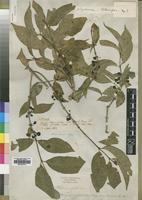
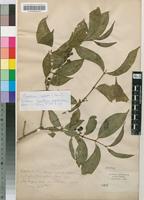
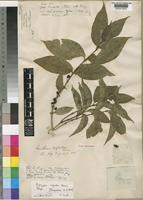
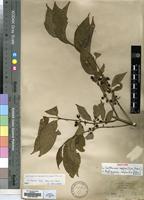
Canthium neglectum

4 Images see all

Type of Canthium neglectum Hiern [family RUBIACEAE]
Isotype of Canthium neglectum Hiern [family RUBIACEAE]
Rytigynia neglecta (Hiern) Robyns [family RUBIACEAE]
Isotype of Canthium neglectum Hiern [family RUBIACEAE]
Previous
Next

Name

Identification
Rytigynia neglecta (Hiern) Robyns [family RUBIACEAE ] (stored under name); Canthium neglectum Hiern [family RUBIACEAE ]
Related name
  • Rytigynia ituriensis
  • Rytigynia neglecta
  • Canthium neglectum

Flora

Entry for CANTHIUM neglectum Hiern [family RUBIACEAE]
Herbarium
Royal Botanic Gardens, Kew (K)
Collection
Flora of Tropical Africa
Resource Type
Reference Sources
Entry From
Flora of Tropical Africa, Vol 1, page 33, (1877) Author: (By Mr. W. P. Hiern.)
Names
CANTHIUM neglectum Hiern [family RUBIACEAE]
Information
Glabrous large tree-like unarmed shrub, rather lucid, with elongated erect-patent rather ashy terete branches, somewhat compressed towards the extremities. Leaves elliptical, acuminate, wedge-shaped or partly obtuse at the base, chartaceous, of nearly the same colour on the two surfaces, 3–4 by 1–1 1/2 in.; lateral veins about 6–7 pairs, inconspicuous; petiole 1/6– 1/4 in.; stipules connate, sheathing, subulate-apiculate, intra-petiolar, hairy inside, 1/8– 1/4 in. long. Fruiting pedicels 1/4 in. long, rather slender, fasciculate, several together in the axils of fallen leaves. Fruit 1/4 in. long, obovoid, obliquely narrowed at the base. Calyx-limb short, after the fall of the corolla with minute subulate teeth. Ovary and ovules of the genus.
Distribution
Abyssinia Nile Land 7000–8000 feet alt., Schimper!

Related Materials

  • Terms and Conditions
  • Privacy Policy
  • Cookie Policy
  • Cookie Settings
  • Accessibility
  • Help
  • Contact Us
  • Facebook
  • Twitter
ITHAKA

JSTOR is part of ITHAKA, a not-for-profit organization helping the academic community use digital technologies to preserve the scholarly record and to advance research and teaching in sustainable ways.

©2000-2026 ITHAKA. All Rights Reserved. JSTOR®, the JSTOR logo, JPASS®, Aluka®, and ITHAKA® are registered trademarks of ITHAKA.

╳