JSTOR Global Plants Home
  • Home
  • Browse
  • About
  • Access
  • Account
    • Saved Items
    • Profile
  • Log in

Global Plants

Skip to Main Content
  • JSTOR Global Plants Home
  • Global Plants

    • Browse
    • About
    • Access
    • Account
      • Saved Items
      • Profile
Log in
  • Browse
  • About
  • Access
  • Account
    • Saved Items
    • Profile
Advanced Search

Compilation
Cyclantheropsis parviflora

3 Images see all

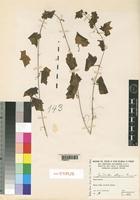
Gerrardanthus aethiopicus Chiov. [family CUCURBITACEAE]
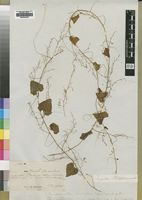
Type of Cyclantheropsis parviflora (Cogn.) Harms [family CUCURBITACEAE]
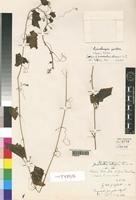
Gerrardanthus aethiopicus Chiov. [family CUCURBITACEAE]
Previous
Next

Name

Identification
Cyclantheropsis parviflora (Cogn.) Harms [family CUCURBITACEAE ] (stored under name);
Related name
  • Cyclantheropsis parviflora
  • Gerrardanthus aethiopicus

Flora

Entry for CYCLANTHEROPSIS parviflora (Cogn.) Harms [family CUCURBITACEAE]
Herbarium
Royal Botanic Gardens, Kew (K)
Collection
Flora of Tropical East Africa
Resource Type
Reference Sources
Entry From
Flora of Tropical East Africa, page 1, (1967) Author: C. Jeffrey
Names
CYCLANTHEROPSIS parviflora (Cogn.) Harms [family CUCURBITACEAE], in E.J. 23: 169 (1896); A. Zimm., Cucurbitac. 2: 4, 6, 10, 11, 12, 15, 43, 54, 56, 60, 70, 73, 82, 110, 111, figs. 29, 68 (1922); R. & A. Fernandes in Mem. Junta Invest. Ultram., sér. 2, 34: 43 (1962). Type: Zanzibar I., Hildebrandt 1140 (W, holo., L, iso.!)
Gerrardanthus parviflorus Cogn. [family CUCURBITACEAE], in DC., Monogr. Phan. 3: 936 (1881)
Gerrardanthus aethiopicus Chiov. [family CUCURBITACEAE], Miss. Biol. Borana Racc. Bot. Ang.-Gym.: 233, fig. 74 (1939). Type: Ethiopia, Galla-Sidamo, Malca Guba, Cufodontis 143 (FI, holo.!)
Information
Perennial climber to 5 m.; stem-base swollen, tuberous; young stems herbaceous, puberulous, becoming more woody and grey-barked when older. Leaf-blade ovate- or reniform-cordate in outline, appearing glabrous but minutely puberulous, subsucculent, acute and apiculate, 21–105 mm. long, 32–100 mm. broad, ± 3–5-lobed with triangular lobes, rarely unlobed; petiole minutely puberulous, 11–41 mm. long. Male flowers in many-flowered up to 120 mm. long panicles; receptacle-tube saucer-shaped; lobes green, triangular, 0.7 mm. long; petals pale greenish-yellow, 1 mm. long; stamen 1, central; thecae 2, horizontal, semicircular, meeting end to end; disk flat, surrounding staminal column. Female flowers 3–6 in 25–45 mm. long panicles or racemes; peduncle 5–10 mm. long; pedicels 4–6 mm. long; ovary 3–6 mm. long, 1–1.5 mm. across, compressed; lobes ovate-lanceolate, 1 mm. long; petals 1.2 mm. long; disk annular, 3-angled; styles very short. Fruits 1–4, pendulous on 5–10 mm. long pedicels, light brown, indehiscent, 31–55 mm. long, 15–22 mm. across the faces. Seed solitary, elliptic in outline, slightly rough, ± 11 × 8 × 3 mm. Fig. 26, p. 149.
Range
DISTR. K1, 7; T2, 3, 5, 6; Z southern Ethiopia; south tropical Africa
Altitude range
75–1150 m.
Distribution
KENYA Northern Frontier Province Moyale, 2 Nov. 1952, Gillett 14122! & Dandu, 9 May 1952, Gillett 13124!KENYA Lamu District Witu, Mkune Forest, Jan. 1956, Rawlins 325!TANGANYIKA Pare District N. end of Pare Mts. near Ruvu R., 4 Nov. 1955, Milne-Redhead & Taylor 7227! & 7227A!TANGANYIKA Lushoto District about 5 km. S. of Mashewa, forest bordering Kumba swamp, 29 June 1953, Drummond & Hemsley 3081! & 3082!TANGANYIKA Ulanga District near Mahenge, Tabora, 20 Jan. 1932, Schlieben 1638!ZANZIBAR Zanzibar I., Oct. 1873, Hildebrandt 1140!
Notes
Further relating to pp. 27, 28. Recent work by Keraudren has shown that two species have been confused here. The description of the fruit and seeds and the synonyms marked with an asterisk pertain in fact to a distinct allied species, which is to be called M. parvifolia Cogn. This species is distinguished from M. multiflora Hook. f. (which has, fide Keraudren, a terete ovoid fruit) by its ribbed cylindrical fruit, inverted U-shaped (not straight or merely curved) anther-thecae and basally spotted petals. It has not been recorded from the area of this Flora.

Related Materials

  • Terms and Conditions
  • Privacy Policy
  • Cookie Policy
  • Cookie Settings
  • Accessibility
  • Help
  • Contact Us
  • Facebook
  • Twitter
ITHAKA

JSTOR is part of ITHAKA, a not-for-profit organization helping the academic community use digital technologies to preserve the scholarly record and to advance research and teaching in sustainable ways.

©2000-2026 ITHAKA. All Rights Reserved. JSTOR®, the JSTOR logo, JPASS®, Aluka®, and ITHAKA® are registered trademarks of ITHAKA.

╳