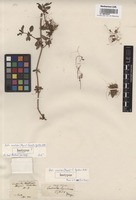
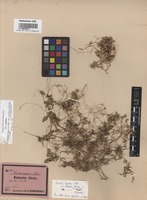
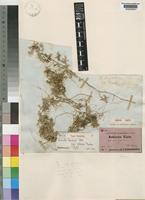
Stems usually very slender, yellowish. Flowers 2.5-3.5 mm long, in umbellate cymes on short pedicels, thin in texture, 5- or someÂtimes 4-merous, shining and yellowish when dry. Calyx campanulate-turbinate; triangular or ovate-lanceolate lobes very acute to acuminate, longer than or ± as long as tube, erect to reflexed. Corolla campanulate; lobes narrow and very acute, erect or spreading, usually longer than tube. Stamens shorter than corolla lobes; anthers as long as or shorter than filaÂments. Scales none. Ovary globose; styles slenÂder, as long as or longer than ovary, subequal. Capsule globose, irregularly circumscissile near base. Seeds ovoid, ± 1.5 mm long; hilum short. Flowering time December to March.
Habitat
Apparently prefers open vegetation in rather dry country where it usually grows on species of Trianthema and Tribulus. Notable for the absence of infrastaminal scales inside the flowers.
Use
7. Cuscuta hyalina Roth, Novae plantarum species praesertim Indiae orientalis: 100 (1821); Baker & Rendle: 205 (1905-06); Yunck.: 235, fig. 107 (1932); Verde: 85 (1953); A.Meeuse: 650 (1957a); Verde: 8 (1963a); Roessler: 1 (1967b); Gone.: 133 (1987); Lejoly & LisowÂski: 6 (1993a); Retief & P.P.J.Herman: 381 (1997). Type: India 'orientale', Heyne s.n. (B, holo.t; K).
Range
This species occurs from India to Ethiopia and the Sudan, extending towards the drier areas of Namibia, the Northern Province and Northern Cape in southern Africa. Map 4.