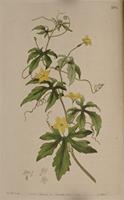
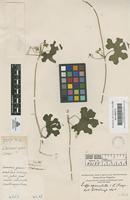
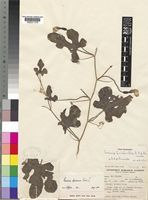
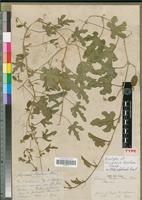
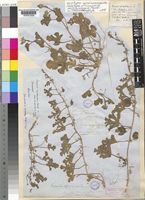
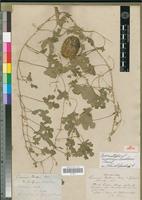
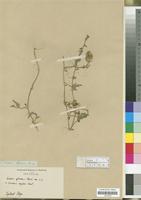
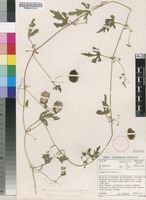
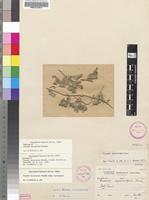
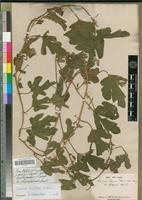
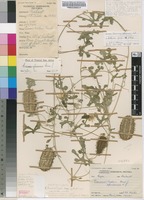
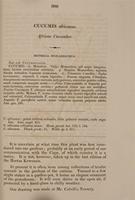
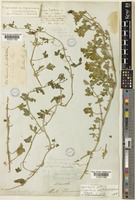
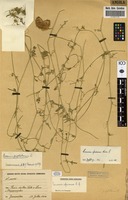
annual, green, scabrous everywhere; branches angulate; leaves deeply 3- or 5- lobed, lobes entire or sublobed, denticulate, as well as the sinus rotundate, middle lobe obovate, longer than the lateral ones; ovary oblong, muricate-echinate, on a slender peduncle; pepo ovoid, densely beset with short, but sharp spines. Stem much branched. Leaves on longish petioles, in var. α. 1 1/4–1 3/4 inch long, 1–1 1/2 inch wide, the upper smaller; in var. β. 1 1/2–2 1/2 inches long, and very similar to those of C. Anguria, L. Male flowers fascicled, very small, much shorter than the hispid petiole; female flowers on longer peduncles. Fruit 1 1/2 inch long, 3/4 or nearly 1 inch broad. Spines 2 lines long; the ripe fruit sometimes denudate or only tubercled by the remaining base of the spines. Seeds nearly 2 lines long. C. arenarius, Schrad.! E. & Z.! 1795, founded on a single specimen, is a depauperated state of C. Africanus. C. arenarius, Arn. and Planch. in herb. Hook. is C. myriocarpus, Naud. C. arenarius, Schum. and Thom.! is a quite different plant; the branches are hispid, tendrils very long, leaves about 2 inches long, 15 lines broad, bluntish-5-lobed, the ovate middle lobe 1 inch long, the four lateral ones short but equal; the whole leaf on both sides subsilky by appressed hairs, a little hispid on the nerves beneath; flowers very small, fascicled and short peduncles, the tube hirsute; the fruit unknown. N. 4919 of Drege's collection has some resemblance to this, but the flowers are much larger, the tendrils very short, and the branches pubescent.