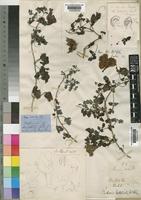
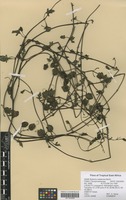
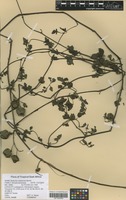
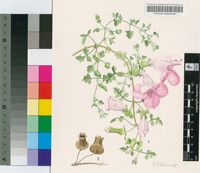
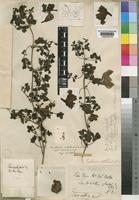
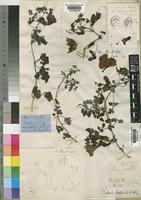
suffruticose; stems pubescent above with short pallid hairs, glabrous below, somewhat woody or wiry, herbaceous towards the end, rambling or climbling, moderately leafy, apparently several feet long; leaves opposite, sparingly pinnatisect or pinnatifid, toughly herbaceous, scabrid-puberulous, turning dusky when dried, 1 1/2–3 in. long, including the petiole, 3/4–1 1/2 in. broad; lower pinnæ opposite, ovate or oval, obtuse, sparingly-toothed or incise, narrowed or quasipetiolulate at the base, 1/4– 1/2 in. long, 1/6– 1/2 in. broad; upper pinnæ smaller; petioles 3/4–1 1/2 in. long; flowers axillary or rather supraaxillary, solitary, violet-scented, about 1 1/2 in. long; peduncles robust, spreading, 1/2–1 in. long; bracteoles 2, opposite, suborbicular, 1/4– 1/2 in. in diam., sessile at the base of the calyx, glabrous or minutely sessile-glandular; calyx campanulate or urceolate, pale green, 1/2– 3/4 in. long in flower, 3/4– 5/6 in. long in fruit, 2/5– 3/5 in. broad in flower, 10-nerved, net-veined, minutely puberulous or glabrous, shortly 4- or 5-lobed; lobes depressed-ovate, 1/8– 1/6 in. long, 1/5– 1/3 in. broad; corolla rosy, glabrous, thin; tube broadly funnel-shaped, somewhat ventricose, curving upwards, about 1 1/4 in. long; throat dark-rosy; limb spreading-recurving, 1 1/2–2 1/2 in. in diam.; lobes 1/2– 3/4 in. long, 3/4–1 1/4 in. broad; stamens glabrous; filaments 1/4– 1/2 in. long, flexuous; anthers 2-celled, polliniferous cells about 1/6 in. long, empty ones of the shorter stamens about 1/5 in. long and flexuous; style exserted, glabrous; capsule about 3/4 in. in diam.; seeds 1/10– 1/8 in. long. null