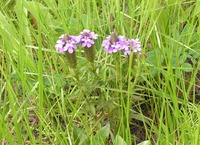
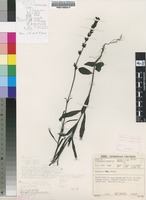
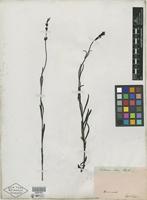
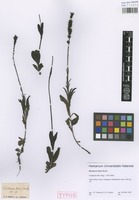
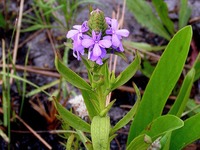
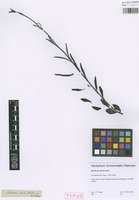
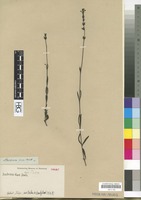
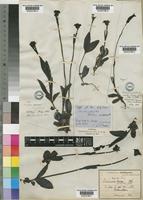
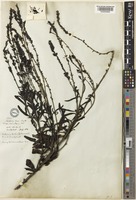
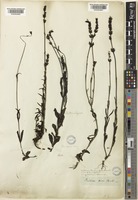
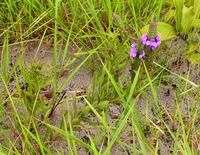
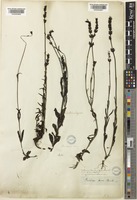
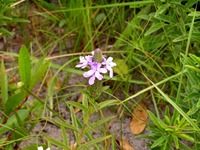
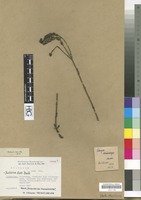
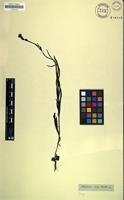
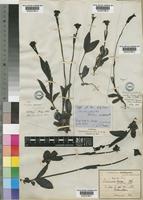
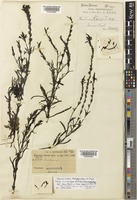
an erect or suberect herb, hispidulous or nearly glabrous, somewhat scabrid, 1/2–2 ft. high, simple or branched, rigid, apparently annual, turning black in drying; stems firm, rather slender, obtusely quadrangular or near the base subterete, furrowed above, somewhat woody at the base, leafy; branches ascending or suberect; leaves opposite or the upper alternate, obovate, oblanceolate or sublinear, rounded or obtuse, attenuate or somewhat narrowed at the base, sessile or subpetiolate, entire, firmly herbaceous, hispidulous-scabrid, 1/2–2 1/2 in. long, 1/24– 5/8 in. broad, the lower the broader and 3-nerved; flowers spicate, numerous, deep purple or pale lilac, about 3/8 in. long; spikes elongating, narrow, dense above, at length lax and interrupted below, not markedly tetragonal, 1–7 in. long; pedicels very short; bract ovate, concave, acute, clasping the calyx, ciliate, otherwise glabrous, 1/8– 1/4 in. long; bracteoles smaller, acute or subulate, 1/10– 1/6 in. long; calyx oblong, 1/5– 1/3 in. long in flower, 1/4 in. long in fruit; tube 1/8– 1/5 in. long, glabrous or nearly so, 8- or 10-ribbed; lobes 4 or 5, ovate or lanceolate or subulate, acute, ciliate, otherwise glabrous, unequal, 1/24– 1/12 in. long; corolla-tube slender, about 1/3– 3/8 in. long, finely and sparingly pilose outside; limb at length spreading, quincuncial in bud; lobes oval or obovate, glabrous on both faces, 1/12– 1/5 in. long, rounded at the apex, emarginate, minutely undulate on the margin; stamens and style included within the corolla-tube; capsule oval-oblong, about 1/4 in. long; seeds irregularly oval or oblong, numerous, nerved, somewhat reticulate. null