JSTOR Global Plants Home
  • Home
  • Browse
  • About
  • Access
  • Account
    • Saved Items
    • Profile
  • Log in

Global Plants

Skip to Main Content
  • JSTOR Global Plants Home
  • Global Plants

    • Browse
    • About
    • Access
    • Account
      • Saved Items
      • Profile
Log in
  • Browse
  • About
  • Access
  • Account
    • Saved Items
    • Profile
Advanced Search

Compilation
Buchnera cernua

4 Images see all

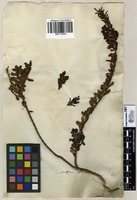
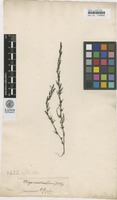
Filed as Chascanum cernuum E.Mey. [family VERBENACEAE]
Buchnera cernua L. [family OROBANCHACEAE]
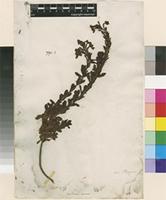
Lectotype of Buchnera cernua L. [family OROBANCHACEAE]
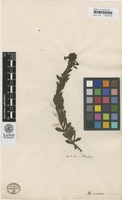
Buchnera cernua L. [family OROBANCHACEAE]
Previous
Next

Name

Identification
Buchnera cernua L. [family OROBANCHACEAE ] (stored under name); Verified by Not on sheet, Plexipus cernuus (L.) R.Fern. [family VERBENACEAE ] Verified by Not on sheet,
Related name
  • Plexipus cernuus
  • Buchnera cernua

Flora

Entry for BOUCHEA cuneifolia Schauer [family VERBENACEAE]
Herbarium
Royal Botanic Gardens, Kew (K)
Collection
Flora Capensis
Resource Type
Reference Sources
Entry From
Flora Capensis, Vol 5, page 180, (1912) Author: By H. H. W. PEARSON.
Names
BOUCHEA cuneifolia Schauer [family VERBENACEAE], in DC. Prod. xi. 559;—Harvey, Thes. Cap. i. 18, t. 28.
Buchnera cuneifolia Thunb. [family SCROPHULARIACEAE], Fl. Cap. ed. Schult. 466.
Buchnera cernua Houtt. [family SCROPHULARIACEAE], Handl. ix. 542, t. 58, fig. 2.
Phryma dehiscens Linn. fil. [family PHRYMACEAE], Suppl. 277.
Chascanum cuneifolium E. Meyer [family VERBENACEAE], Comm. 276; Maund and Hensl. Botanist, iv. 196; Hochst. in Flora, 1845, 68.
Deniseia dehiscens O. Kuntze [family ], Rev. Gen. Pl. iii. 250.
Information
a much branched low undershrub, 1–1 1/2 ft. high; branches tetragonal, with 2 opposite lines of pubescence alternating in successive internodes; leaves broadly cuneate or oblong-cuneate, narrowed into the short petiole, with a rounded apex, coarsely and acutely dentate, thick, obscurely veined, sparsely puberulous on the margins and midrib near the base, otherwise glabrous, 1/2–1 in. long, 1/4– 1/2 in. broad; raceme lax, minutely puberulous, 3–6 in. long; flowers white; bracts linear-subulate, minutely puberulous, 1–2 lin. long; bracteoles triangular-subulate, 1/4– 1/2 lin. long; calyx equally 5-toothed, obscurely pubescent, 4–5 lin. long; teeth 1/6– 1/4 lin. long; corolla-tube curved, glabrous, 9–10 lin. long; lobes subequal, oblong or obovate, rounded or slightly emarginate at the apex, glabrous, 2–3 lin. long; filaments glandular-puberulous; fruit oblong, sculptured, 2 1/2–3 lin. long, 1 lin. broad; areole basal. null
Distribution
CENTRAL REGION Prince Albert Div.; on rocky hills near Weltevrede, 2500–3000 ft., Drège! Somerset Div.; near Somerset East, Bowker! Graaff Reinet Div.; in stony places near Graaff Reinet, 2500 ft., Bolus! in rocky soils of the Karoo country, Bowie!COAST REGION Mossel Bay Div.; on dry hills on the Eastern side of Gauritz River, Burchell, 6427! Uitenhage Div.; on the slopes of Winterhoek Mountains, 1000 ft., Krauss, 1129! Addo, 1000–2000 ft., Ecklon & Zeyher, 3547! Zeyher, 842! and without precise locality, Alexander! Alexandria Div.; on the Zuurberg Range, 2000 ft., Drège! Albany Div.; Fish River Heights, Hutton! near Grahamstown, MacOwan, 125! near Glenfilling, 1000 ft., Drège! in calcareous places on the hills of the eastern side of the Bushmans River, Zeyher, 842! Fort Beaufort Div.: without precise locality, Ecklon & Zeyher! between Konap River and Enon, Baur, 1053! Peddie Div.; Fredricksburg, Gill! King Williamstown Div.; on stony hills around King Williamstown, 1500 ft., Tyson in MacOwan & Bolus, Herb. Norm. Aust.-Afr., 841! Kuntze. Queenstown Div.; lower slopes of mountains near Queenstown, 3900 ft., Galpin, 1665! British Kaffraria; without precise locality, Cooper, 209! 377! 378! Eastern Frontier, Hallack!EASTERN REGION Natal; Umkomaas (Umkomanzi) Cutting, Wood, 877! near Durban, below 400 ft., Drège! near the Mooi River, Gerrard and McKen, 1245!SOUTH AFRICA without precise locality, Oldenburg! Forster! Holland, 60!

Related Materials

  • Terms and Conditions
  • Privacy Policy
  • Cookie Policy
  • Cookie Settings
  • Accessibility
  • Help
  • Contact Us
  • Facebook
  • Twitter
ITHAKA

JSTOR is part of ITHAKA, a not-for-profit organization helping the academic community use digital technologies to preserve the scholarly record and to advance research and teaching in sustainable ways.

©2000-2026 ITHAKA. All Rights Reserved. JSTOR®, the JSTOR logo, JPASS®, Aluka®, and ITHAKA® are registered trademarks of ITHAKA.

╳