JSTOR Global Plants Home
  • Home
  • Browse
  • About
  • Access
  • Account
    • Saved Items
    • Profile
  • Log in

Global Plants

Skip to Main Content
  • JSTOR Global Plants Home
  • Global Plants

    • Browse
    • About
    • Access
    • Account
      • Saved Items
      • Profile
Log in
  • Browse
  • About
  • Access
  • Account
    • Saved Items
    • Profile
Advanced Search

Compilation
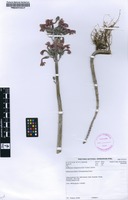
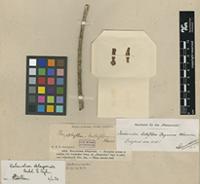
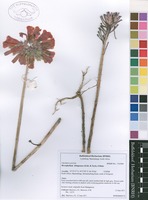
Bryophyllum delagoense

3 Images see all

Filed as Bryophyllum delagoense (Eckl. & Zeyh.) Schinz [family CRASSULACEAE]
Type of Kalanchoe delagoensis Eckl.&Zeyh. [family CRASSULACEAE]
Filed as Bryophyllum delagoense (Eckl. & Zeyh.) Schinz [family CRASSULACEAE]
Previous
Next

Name

Identification
Kalanchoe delagoensis Eckl.&Zeyh. [family CRASSULACEAE ] (stored under name); Verified by Not on sheet, Bryophyllum tubiflorum Harv. [family CRASSULACEAE ] Verified by Harvey, W.H., Kalanchoe tubiflora (Harv.) Raym.-Hamet [family CRASSULACEAE ] Verified by Hamet, R., 1913 Kalanchoe delagoensis Eckl.&Zeyh. [family CRASSULACEAE ] Verified by Tölken, H.R., 1976 Bryophyllum delagoense (Eckl.&Zeyh.) Schinz [family CRASSULACEAE ] Verified by Not on sheet,
Related name
  • Bryophyllum tubiflorum
  • Kalanchoe delagoensis
  • Bryophyllum delagoense
  • Kalanchoe tubiflora
Common name
  • tingo tingo, Flora of North America Vol. 8
  • Chandelier plant, Flora of North America Vol. 8

Flora

Entry for Bryophyllum delagoense [family CRASSULACEAE]
Herbarium
South African National Biodiversity Institute, Compton Herbarium, Cape Town (SAM)
Collection
Flora of Southern Africa
Resource Type
Reference Sources
Entry From
Flora of South Africa, (2003) Author: Dr J.P. Roux
Names
Bryophyllum delagoense [family CRASSULACEAE]
Common names
Kalanchoe delagoensis Eckl. & Zeyh., Enum. 305 (1837). Bryophyllum tubiflorum Harv. in F.C. 2: 380 (1862); R. Fernandes in C.F.A. 70: 33 (1982); in F.Z. 7,1: 67 (1983), nom. superfl.; Kalanchoe tubiflora R.-Hamet in Bot. Zbl., Beiheft 29: 41 (1912); Jacobsen, Handb. Succ. PI. 2: 667, fig. 895 (1960); R.-Hamet & Marnier-Lapostolle in Archs Mus. natn. Hist, nat., Paris, ser. 7, 8: 60, figs 70, 71 (1964); Jacobsen, Sukk. Lex. 256, fig. 103, 3 (1970). Type: same as for B. delagoense.
Information
Sparse glabrous shrublets up to 2 m high, with one or few erect terete branches, often growing in dense stands; roots not thickened. Leaves ternate, to apparently op­posite or alternate, sessile, glabrous, terete, (20-)25-80(-120) x (2-)3-5 mm in diam. with 5-8 apical teeth producing pseudobul­bils in their axils, more or less grooved above, grey-green and with darker spots. In­florescence a rounded thyrse with several closely clustered dichasia. Calyx with lobes triangular-lanceolate, 5-10 mm long. Co­rolla pale orange to deep magenta; tube widened in middle and at throat, 25-33 mm long, lobes oblong-obovate, 8-12 x 6-9 mm. Anthers 2-2,5 mm long. Squamae ob­long to almost square, 1,3-2 mm long, rounded at apex. Seeds 2-2,5 mm long. Fig. 10.
Habitat
R.-Hamet (1912), and probably also Harvey (1862), regarded Kalanchoe delagoensis Eckl. & Zeyh. as a nomen nudum. However, the diagnosis 'Flores saturate rosei', given by Ecklon & Zeyher, distin­guishes the species from all other species enumerated. Even today the species can be identified with the aid of the fragmentary type specimen on which Harvey also based his Bryophyllum tubiflorum. He even cited Ka­lanchoe delagoensis as synonym under his new name. Although B. tubiflorum Harv. is thus a superfluous name, K. tubiflora R.-Hamet is not illegitimate (I.C.B.N., Article 72, Note 1).
Use
Bryophyllum delagoense (Eckl. & Zeyh.) Schinz in Mem. Herb. Boiss. 10: 38 (1900); Druce in Rep. botl Soc. Exch. Club Br. Isl. 1916: 611 (1917). Type: Cape, Dela-goa Bay?, Owen s.n. (S, holo.!).
Range
Found in disturbed areas and on roadsides, espec­ially in sheltered frost-free areas of the eastern Trans­vaal, but also often seen as a garden escape in and around towns.

Related Materials

  • Terms and Conditions
  • Privacy Policy
  • Cookie Policy
  • Cookie Settings
  • Accessibility
  • Help
  • Contact Us
  • Facebook
  • Twitter
ITHAKA

JSTOR is part of ITHAKA, a not-for-profit organization helping the academic community use digital technologies to preserve the scholarly record and to advance research and teaching in sustainable ways.

©2000-2026 ITHAKA. All Rights Reserved. JSTOR®, the JSTOR logo, JPASS®, Aluka®, and ITHAKA® are registered trademarks of ITHAKA.

╳