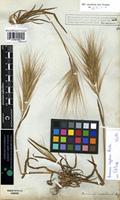
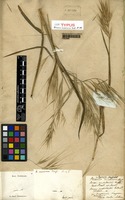
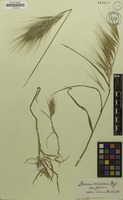
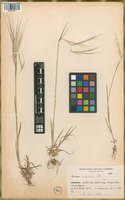
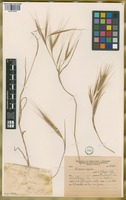
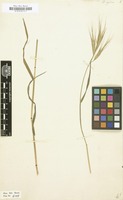
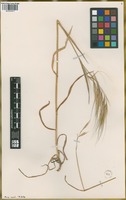
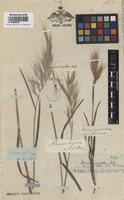
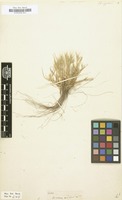
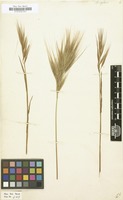
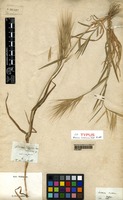
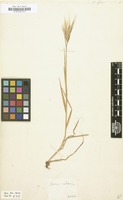
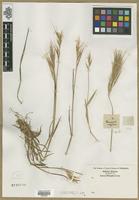
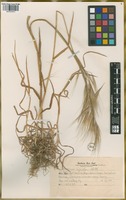
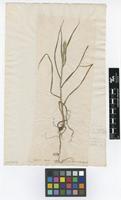
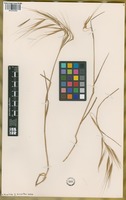
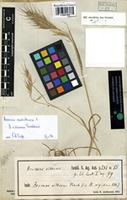
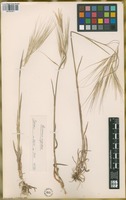
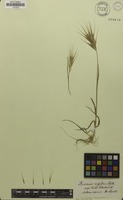
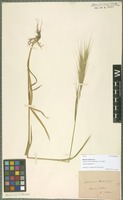
annual; culms erect or subascending, geniculate, 1–2 ft. high, glabrous or pubescent to finely villous in the upper part, 5–7-noded, leafy all along, upper internodes usually exserted; leaves scantily to densely hairy all over or almost glabrous; sheaths tight, thin, strongly striate; ligules hyaline, delicate, 2–2 1/2 lin. long, fimbriate-toothed; blades linear, tapering to an acute point, 4–12 in. by 2–4 lin., flat, subflaccid, dark green, margins scaberulous; panicles erect or slightly nodding, more or less contracted, 4–9 in. long (inclusive of the awns); axis terete, striate, scaberulous to hispidulous; branches 3–6-nate, unequal, 2–1- (rarely 3-) spiculate, longest 2–3 in. long, filiform, flexuous, scabrid to minutely hispid or villous; lateral pedicels short, rather stout; spikelets cuneate (when open), 1 1/4–1 3/4 in. long, green, 5–7-flowered; rhachilla slender, scabrid, joints 2–3 lin. long; glumes subulate to lanceolate-subulate in profile, finely acuminate, green along the nerves, otherwise scarious, lower 1- to sub-3-nerved, 7–10 lin. long, upper broader, 3-nerved, 11–14 lin. long, keels scabrid; valves linear-lanceolate, acuminate, about 1 in. long, 7-nerved, scabrid, upper margins and the finely bifid tips hyaline, white; awn permanently straight, scabrid, 2–2 1/2 in. long; callus 1/2 lin. long; pales narrow, about 7 lin. long, keels remotely rigidly ciliolate; stamens 3 (in the South African specimens) or 2; anthers 3/4–1 1/2 lin. long; ovary pubescent just below the appendage; grain linear, about 7 lin. long, strongly convexo-concave. null