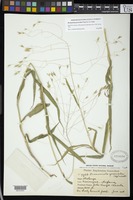
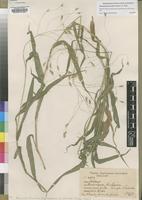
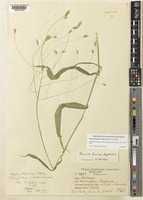
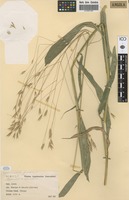
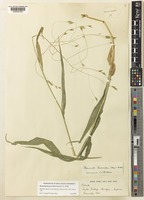
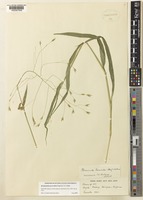
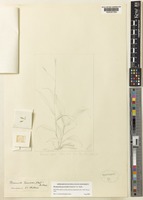
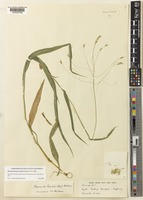
Perennial, from a creeping rhizome; culms 60–120 cm. high. Leaf-blades lanceolate, 10–20 cm. long and 1–2 cm. wide, attenuate at the base, acuminate, sparsely pilose, the veins transversely connected; ligule scarious, 0.5 mm. long, ciliolate; sheath glabrous except for the margins. Panicle broadly ovate, 11–20 cm. long, diffuse with spreading branches. Spikelets oblong, 10–17 mm. long, solitary, long-pedicelled; glumes narrowly ovate, 5-nerved, the lower 5–7.5 mm. long, the upper 6–8 mm. long; barren lemma 9 mm. long, with a short awn-point; lemmas elliptic-ovate, 6–9.5 mm. long, minutely bidentate or emarginate, with a short awn up to 3 mm. long; palea oblong, strongly gibbous, densely puberulous on the sides and ciliolate on the keel. Fig. 51.
Range
DISTR. T7
Altitude range
± 2000 m.
Distribution
TANGANYIKA Iringa District Dabaga Highlands, Ihangana Forest Reserve, 14 Feb. 1962, Polhill & Paulo 1477!TANGANYIKA Njombe District Uwemba, Childs 205!
Distribution (external)
Zambia
Angola
Notes
The only East African specimens lack the characteristic sterile lemma at the base of the spikelet, and the awns are poorly developed or even lacking. Similar modifications can be observed in plants grown at Kew from seed of typical Zambian specimens, indicating that the species is naturally rather variable.