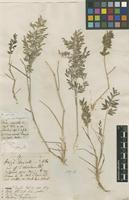
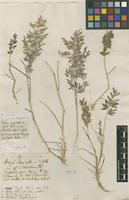
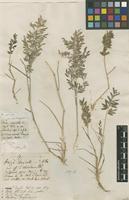
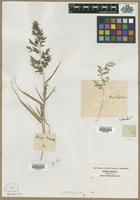
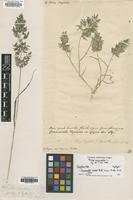
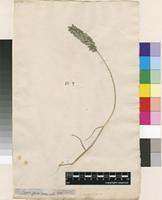
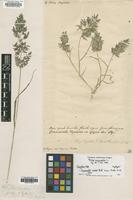
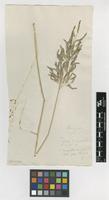
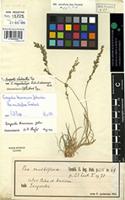
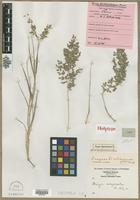
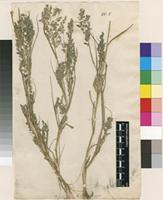
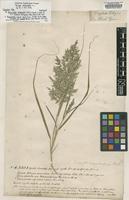
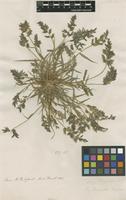
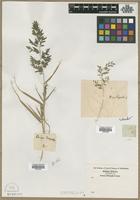
annual, tufted; culms geniculate-ascending or suberect, usually stout and branched below, 1/2–2 ft. long, glabrous, smooth, 3–4-noded, internodes more or less exserted; sheaths loose, strongly striate, keeled in the upper part, often glandular, particularly on the keel and the nerves above, glabrous or scantily hairy, bearded; ligule a fringe of short hairs; blades linear or lanceolate-linear, long tapering to a fine point, 2–6 in. by 1 1/2–4 lin., flat, more or less flaccid, light green or subglaucous, glabrous or very scantily hairy, smooth below, scaberulous above, usually glandular along the margins; panicle oblong to ovate-oblong, stiff, 2 to more than 6 in. long, dense or rather lax; axis terete, smooth; branches subsolitary, spreading, stiff or flexuous, lowest up to 3 1/2 in. long or all short, branched from near the base; lateral pedicels 1/2–1 1/2 lin. long, all the divisions filiform, angular, scabrid; spikelets linear to ovate-oblong, 2–6 lin. long by 1 to almost 2 lin., subflexuous if very long, light or dark olive-green, few- to 50-flowered; rhachilla persistent; glumes subequal, ovate oblong, subobtuse to acute, 3/4 or almost 1 lin. long, 1- (or the upper 3-) nerved, keels scabrid, margins minutely serrulate; valves broadly and obliquely ovate in profile, obtuse or subobtuse, 1–1 1/4 lin. long, side-nerves prominent, strong; pales persistent, somewhat shorter than the valves, broad, keels scabrid or ciliolate; anthers oblong, about 1/5– 1/4 lin. long; grain globose, brown, loose within the turgid valves, 1/3– 1/4 lin. in diameter. null