JSTOR Global Plants Home
  • Home
  • Browse
  • About
  • Access
  • Account
    • Saved Items
    • Profile
  • Log in

Global Plants

Skip to Main Content
  • JSTOR Global Plants Home
  • Global Plants

    • Browse
    • About
    • Access
    • Account
      • Saved Items
      • Profile
Log in
  • Browse
  • About
  • Access
  • Account
    • Saved Items
    • Profile
Advanced Search

Compilation
Brillantaisia debilis

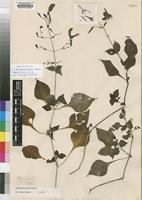
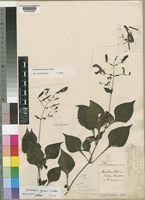
2 Images see all

Isolectotype of Brillantaisia debilis Burkill [family ACANTHACEAE]
Type of Brillantaisia debilis Burkill [family ACANTHACEAE]
Previous
Next

Name

Identification
Brillantaisia debilis Burkill [family ACANTHACEAE ] (stored under name); Verified by Sidwell,K.,
Related name
  • Brillantaisia debilis
  • Brillantaisia soyauxii
  • Brillantaisia preussii

Flora

Entry for Brillantaisia debilis Burkill [family ACANTHACEAE]
Herbarium
Royal Botanic Gardens, Kew (K)
Collection
Flora of Tropical Africa
Resource Type
Reference Sources
Entry From
Flora of Tropical Africa, page 1, (1900) Author: (By I. H. Burkill and C. B. Clarke.)
Names
Brillantaisia debilis Burkill [family ACANTHACEAE]
Information
A weak plant growing in wet places. Stem glabrous. Leaves ovate, narrow below, with a short wing, acuminate above, almost entire, glabrous on both sides, 2 1/2 in. long, 1 1/2 in. wide. Inflorescence lax, few-flowered, glabrous; bracts lanceolate. Calyx-segments linear, nearly equal, fringed with glandular hairs. Corolla-tube 5 lin. long; lips 8 lin. long, dark purple, the upper sparingly hairy outside. Staminodes densely covered with short glandular hairs. Style hairy. Ovary 10 lin. long, glabrous, with about 20 seeds to each valve.
Distribution
Cameroons Upper Guinea Efulen, Bates, 350!

Related Materials

  • Terms and Conditions
  • Privacy Policy
  • Cookie Policy
  • Cookie Settings
  • Accessibility
  • Help
  • Contact Us
  • Facebook
  • Twitter
ITHAKA

JSTOR is part of ITHAKA, a not-for-profit organization helping the academic community use digital technologies to preserve the scholarly record and to advance research and teaching in sustainable ways.

©2000-2026 ITHAKA. All Rights Reserved. JSTOR®, the JSTOR logo, JPASS®, Aluka®, and ITHAKA® are registered trademarks of ITHAKA.

╳