JSTOR Global Plants Home
  • Home
  • Browse
  • About
  • Access
  • Account
    • Saved Items
    • Profile
  • Log in

Global Plants

Skip to Main Content
  • JSTOR Global Plants Home
  • Global Plants

    • Browse
    • About
    • Access
    • Account
      • Saved Items
      • Profile
Log in
  • Browse
  • About
  • Access
  • Account
    • Saved Items
    • Profile
Advanced Search

Compilation
Brexia spinosa

6 Images see all

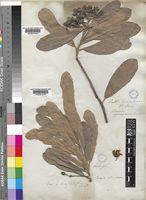
Brexia madagascariensis unrecorded [family ESCALLONIACEAE]
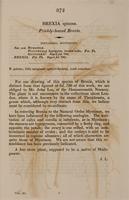
Prickly-leaved Brexia
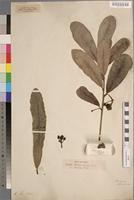
Brexia madagascariensis unrecorded [family ESCALLONIACEAE]
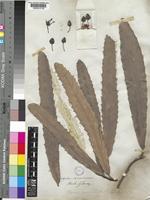
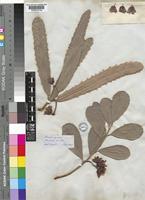
Type of Brexia spinosa Lindl. [family ESCALLONIACEAE]
Brexia madagascariensis unrecorded [family ESCALLONIACEAE]
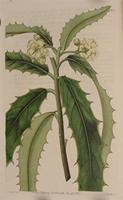
Brexia spinosa. Print from Botanical Register.
Previous
Next

Name

Identification
Brexia spinosa Lindl. [family ESCALLONIACEAE ]
Related name
  • Brexia spinosa

Flora

Entry for Brexia madagascariensis Lam. Ker-Gawl. [family BREXIACEAE]
Herbarium
Royal Botanic Gardens, Kew (K)
Collection
Flora Zambesiaca
Resource Type
Reference Sources
Entry From
FZ, Vol 4, Part 0, page 59, (1978) Author: N. K. B. Robson
Names
Brexia madagascariensis Lam. Ker-Gawl. [family BREXIACEAE], Bot. Reg. 9: t. 730 (1823).—Harv. in Harv. & Sond., F.C. 2: 598 (1862).—Baker, Fl. Maurit. Seychelles: 97 (1877).— Thonn., Blütenfl. Afr.: t. 61 (1908).—Sim, For. Fl. Port. E.A.: 61 (1909).—Engl., Pflanzenw. Afr. 1, 1: 244, t. 211 (1910).—Thonn., Fl. Pl. Afr.: t. 60 (1915).— Engl., Pflanzenw. Afr. 3, 1: 286 (1915); in Engl. & Prantl, Pflanzenf., ed. 2, 18a: 186, t. 104 fig. a-f (1930).—Perr. in Bull. Soc. Bot. Fr. 80: 202 (1933).—Brenan & Greenway, T.T.C.L. 2: 195 (1949).—Williams, Useful & Ornament. Pl. Zanz. & Pemba: 154 (1949).—Gomes e Sousa, Dendr. Moçamb. Estudo Geral. 1: 211, t. 23 (1967).—Verdcourt in F.T.E.A., Brexiaceae: 1, t. 1 (1968). TAB. 17. Type from Madagascar.
Venana madagascariensis Lam. [family BREXIACEAE], Tabl. Encycl. Meth. Bot. 2: t. 131 (1792); 99 (1797).—Poir., Encycl. Méth. Bot. 8: 450 (1808). Type as above.
Brexia spinosa Lindl. [family BREXIACEAE], Bot. Reg. 11: t. 872 (1825).—Colla in Mem. Acad. Torino 35: 151, t. 3 (1831).—Type cultivated ex Madagascar.
Brexia chrysophylla Sweet [family BREXIACEAE], Hort. Brit.: 492 (1827) nom. nud.
Brexia serrata C. B. Presl [family BREXIACEAE], in Walp. Repert. 1: 190 (1834). Type cultivated ex Madagascar.
Brexia heterophylla Bojer [family BREXIACEAE], Hort. Maurit.: 52 (1837).—Tul. in Ann. Sci. Nat. Bot., Sér. 4, 8: 159 (1857) nom. illegit.
Brexia acanthifolia Noronha ex Tul. [family BREXIACEAE], loc. cit. nom. nud. in adnot.
Brexia amplifolia Noronha ex Tul. [family BREXIACEAE], loc. cit. nom. nud, in adnot.
Brexia digyna Noronha ex Tul. [family BREXIACEAE], loc. cit. nom. nud. in adnot.
Brexia ovatifolia Noronha ex Tul. [family BREXIACEAE], loc. cit. nom. synon.
Brexia microcarpa Tul. [family BREXIACEAE], tom. cit.: 160 (1857).—Perrier, tom. cit.: 199 (1933). Type from the Seychelles.
Brexia madagascariensis var. mossambicensis Oliv. [family BREXIACEAE], in F.T.A. 2: 385 (1871). Type: Mozambique, mouth of Zambesi, Kirk (K).
Thomassetia seychellarum Hemsl. [family BREXIACEAE], in Hook., Ic. Pl. 28: t. 2736 (1902). Type from the Seychelles.
Information
Shrub or small tree, (2)3–7(10) m. high, much branched; stems smooth, angular when young, later terete. Leaves evergreen; petiole 1–2 cm. long; lamina 3·5–35 x 2–7·6 cm., very variable in shape, those on young shoots narrowly oblong to oblong-linear with margin spinose-dentate, those on mature shoots narrowly to broadly obovate with margin crenate to entire, all rounded to retuse at the apex, cuneate to rounded at the base, coriaceous; stipules subulate. Inflorescence (l)3–12(17)-flowered, pedunculate, in leaf axils; peduncle 1–9 cm. long, usually ± flattened, 1·5–5 mm. wide, sometimes bearing at the apex 1–2 leaf-like bracteoles c. 1 x 1 cm.; bracteoles otherwise small, scale-like, deciduous; pedicels 0·6–1·8 mm. long. Sepals c. 2·5 x 3·5–4 mm., united in the lower 1/2, with lobes triangular-oblate, apex rounded, margin entire. Petals greenish- or yellowish-white, 1·2–1·7 x 0·9–1·2 cm., broadly oblong-ovoid, obtuse, ± fleshy. Stamens with filaments c. 1·2 mm. thick; anthers c. 5 x 2·5 mm. Disk-lobes with filaments 4–6, linear, unequal. Ovary 5-angled, c. 8–10 mm. long including style. Drupe 4–10 x 1·9–3 cm., ovoid to oblong-fusiform or cylindric, prominently 5-ribbed (in our area), with mesocarp woody at first but said to become eventually pulpy and edible. Seeds 4·5–7·5 x 3–3·5 mm., brown or blackish, irregularly compressed-ellipsoid, carinate, minutely rugulose in ridges.
Habitat
In sclerophyllous coastal scrub, mangrove swamps and fringing forest near the sea
Altitude range
0–40 m.
40
0
Distribution
Mozambique M Inhaca I., west coast, fl. 31.viii.1959, Watmough 329 (K; LISC).Mozambique GI Gaza, praia da Vila Joao Belo, fl. 26.xi.1941, Torre 3880 (BM; LISC).Mozambique MS Beira Distr.. R. Chimziua near sawmills, fr. 28.x.1957, Gomes e Sousa 4426 (COI; K; LMJ).Mozambique Z 32 km. N. of Quelimane, coast, fl. 10.vii.1962, Wild 5873 (COI; K; LISC; SRGH).
Distribution (external)
Tanzania (Tanganyika and Zanzibar)
Comoro Is.
Madagascar
Seychelles
Notes
The variation in Brexia madagascariensis is greatest in Madagascar. No specimens with the long narrow spinous leaves have been seen from Africa or Zanzibar. Plants from these areas have relatively broad obovate entire or subentire leaves which, however, can be matched with Madagascar material. If the lack of spinous leaves proves to be constant on mainland plants, then some infraspecific taxonomic recognition of these populations might be desirable. Likewise, the small-fruited plants from the Seychelles may prove to belong to a distinct species.

Related Materials

  • Terms and Conditions
  • Privacy Policy
  • Cookie Policy
  • Cookie Settings
  • Accessibility
  • Help
  • Contact Us
  • Facebook
  • Twitter
ITHAKA

JSTOR is part of ITHAKA, a not-for-profit organization helping the academic community use digital technologies to preserve the scholarly record and to advance research and teaching in sustainable ways.

©2000-2026 ITHAKA. All Rights Reserved. JSTOR®, the JSTOR logo, JPASS®, Aluka®, and ITHAKA® are registered trademarks of ITHAKA.

╳