JSTOR Global Plants Home
  • Home
  • Browse
  • About
  • Access
  • Account
    • Saved Items
    • Profile
  • Log in

Global Plants

Skip to Main Content
  • JSTOR Global Plants Home
  • Global Plants

    • Browse
    • About
    • Access
    • Account
      • Saved Items
      • Profile
Log in
  • Browse
  • About
  • Access
  • Account
    • Saved Items
    • Profile
Advanced Search

Compilation
Brachystelma zeyheri

4 Images see all

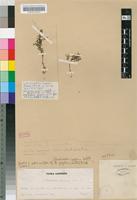
Isotype of Dichaelia zeyheri Schltr. [family APOCYNACEAE]
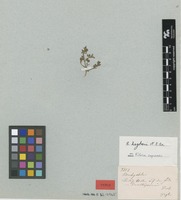
Raphionacme zeyheri Harv. [family ASCLEPIADACEAE]
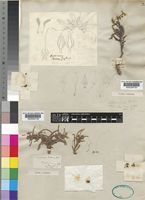
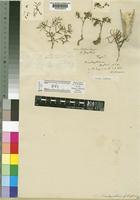
Type of Brachystelma zeyheri N.E.Br. [family ASCLEPIADACEAE]
Previous
Next

Name

Identification
Brachystelma zeyheri N.E.Br. [family ASCLEPIADACEAE ] Verified by Brown, N.E., Brachystelma circinatum E.Mey. [family ASCLEPIADACEAE ] (stored under name); Brachystelma filiforme Harv. [family ASCLEPIADACEAE ]
Related name
  • Brachystelma filiforme
  • Brachystelma not on sheet
  • Dichaelia zeyheri
  • Brachystelma zeyheri
  • Brachystelma circinatum

Flora

Entry for BRACHYSTELMA Zeyheri N. E. Br. [family ASCLEPIADACEAE]
Herbarium
Royal Botanic Gardens, Kew (K)
Collection
Flora Capensis
Resource Type
Reference Sources
Entry From
Flora Capensis, Vol 4, page 518, (1909) Author: By N. E. BROWN.
Names
BRACHYSTELMA Zeyheri N. E. Br. [family ASCLEPIADACEAE]
Dichælia Zeyheri Schlechter [family ], in Engl. Jahrb. xxxviii. 43.
Information
plant 2–5 in. high, branching; branches erect or spreading, puberulous; leaves spreading, 2–6 lin. long, 3/4–1 lin. broad, linear or linear-lanceolate, obtuse or subacute, longitudinally folded, glabrous above, puberulous beneath (“on both sides,” Schlechter), narrowed into a very short petiole at the base; flowers usually in pairs (1–3, Schlechter) at the nodes, small; pedicels 1/2–1 lin. long, puberulous; sepals nearly 1 lin. (1/2 lin., Schlechter) long, lanceolate, acute, puberulous; corolla cage-like, lobed nearly to the base, with the lobes connate at the tips; united part 1/4 lin. long (as long as the sepals, Schlechter), saucer-shaped, glabrous outside and within, green; lobes 2–2 1/4 lin. long, linear or linear-filiform from a lanceolate or ovate-lanceolate base 1/2 lin. broad, perhaps replicate, thinly puberulous on the greenish back, glabrous or very minutely and sparsely papillate-puberulous and dull purplish or brownish-purple on the inner face; outer corona-lobes arising 1/4 lin. up the staminal column and equalling or slightly exceeding it, 1/3– 1/2 lin. long, deeply divided (often nearly to the base) into 2 erect linear parallel or slightly diverging teeth, variable in different flowers, glabrous; inner corona-lobes 1/3– 1/2 lin. long, linear or linear-oblong, obtuse, closely incumbent on the backs of the anthers and equalling or exceeding them and curved downwards over their tips, glabrous; follicles erect, slightly diverging, 2 1/2 in. long, about 2 1/2 lin. thick, tapering into a beak, smooth, glabrous; seeds 3–3 1/2 lin. long, 2 lin. broad, ovate or oblong-ovate, smooth and glabrous, dark brown with a broad pale brown margin. null
Distribution
COAST REGION Uitenhage Div.; near Uitenhage, Zeyher! Witte River Station (Enon), Gill! stony places near the Zwartkops River, Zeyher, 3383 (ex Schlechter).
Notes
Zeyher's plant was quoted by Harvey under B. filiforme, Harv., but is not the plant he figured and described under that name. According to an excellent drawing of B. Zeyheri in the Kew Herbarium, made from a plant introduced by Bowie in 1823, it flowered at Kew in August, 1824.

Related Materials

  • Terms and Conditions
  • Privacy Policy
  • Cookie Policy
  • Cookie Settings
  • Accessibility
  • Help
  • Contact Us
  • Facebook
  • Twitter
ITHAKA

JSTOR is part of ITHAKA, a not-for-profit organization helping the academic community use digital technologies to preserve the scholarly record and to advance research and teaching in sustainable ways.

©2000-2026 ITHAKA. All Rights Reserved. JSTOR®, the JSTOR logo, JPASS®, Aluka®, and ITHAKA® are registered trademarks of ITHAKA.

╳