JSTOR Global Plants Home
  • Home
  • Browse
  • About
  • Access
  • Account
    • Saved Items
    • Profile
  • Log in

Global Plants

Skip to Main Content
  • JSTOR Global Plants Home
  • Global Plants

    • Browse
    • About
    • Access
    • Account
      • Saved Items
      • Profile
Log in
  • Browse
  • About
  • Access
  • Account
    • Saved Items
    • Profile
Advanced Search

Compilation
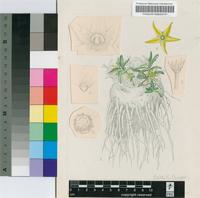
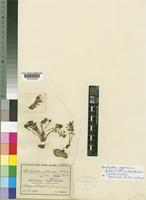
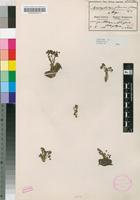
Brachystelma flavidum

3 Images see all

Brachystelma flavidum Schltr.
Type of Brachystelma pygmaeum (Schltr.) N.E.Br. subsp. flavidum (Schltr.) R.A.Dyer [family ASCLEPIADACEAE]
Type of Brachystelma flavidum Schltr. [family APOCYNACEAE]
Previous
Next

Name

Identification
Brachystelma flavidum Schltr. [family APOCYNACEAE ]
Related name
  • Brachystelma flavidum

Flora

Entry for BRACHYSTELMA flavidum Schlechter [family ASCLEPIADACEAE]
Herbarium
Royal Botanic Gardens, Kew (K)
Collection
Flora Capensis
Resource Type
Reference Sources
Entry From
Flora Capensis, Vol 4, page 518, (1909) Author: By N. E. BROWN.
Names
BRACHYSTELMA flavidum Schlechter [family ASCLEPIADACEAE], in Engl. Jahrb. xl. 94
Information
tuber depressed, up to 1 3/4 in. in diam.; stems several (?), branching, about 2 in. high, slender, puberulous, laxly leafy; leaves erectly spreading, not fully developed at the time of flowering, subsessile, up to 7 1/2 lin. long, 1 1/2–2 lin. broad, lanceolate-elliptic, acute, subglabrous; flowers few together in fascicles at the nodes; pedicels 2 lin. long, filiform, puberulous; sepals scarcely 1 1/4 lin. long, lanceolate, acuminate, puberulous; corolla 2 1/2 lin. long, lobed to 2/3 of the way down, entirely glabrous, yellowish; lobes free, spreading, long-acuminate from an ovate base; corona-lobes connate high up, 3-lobed, with the lateral lobes minute, ciliate, and the middle lobe larger, ligulate, obtuse, incurved, glabrous. null
Distribution
EASTERN REGION Natal; Alexandra County, at Fairfield, 2200 ft., Rudatis, 68.
Notes
Said to be allied to B. caffrum, N. E. Br., and B. pulchellum, Schlechter, but distinguished by its more pointed corolla-lobes and different corona.

Related Materials

  • Terms and Conditions
  • Privacy Policy
  • Cookie Policy
  • Cookie Settings
  • Accessibility
  • Help
  • Contact Us
  • Facebook
  • Twitter
ITHAKA

JSTOR is part of ITHAKA, a not-for-profit organization helping the academic community use digital technologies to preserve the scholarly record and to advance research and teaching in sustainable ways.

©2000-2026 ITHAKA. All Rights Reserved. JSTOR®, the JSTOR logo, JPASS®, Aluka®, and ITHAKA® are registered trademarks of ITHAKA.

╳